Human Eye Structure and Functions Explained with Diagram
The eye is among the most significant sense organs in the human body. The eye is an organ that helps us see our environment, colors, movements, and other things around us. For biology research purposes, the knowledge of human eye anatomy is extremely important for the students of CBSE and ICSE board.
In this blog post, we are going to explore the structure of the human eye along with the functioning.
What is the Human Eye?
The human eye is the most important and powerful sense organ in our body. It acts like an autofocus camera which captures light to create a clear image and transmit the message to the brain. It is the most valuable and sensitive organ of human body.
The human eye has almost a spherical structure and is enclosed in the skull and eyelids.
Human Eye Diagram
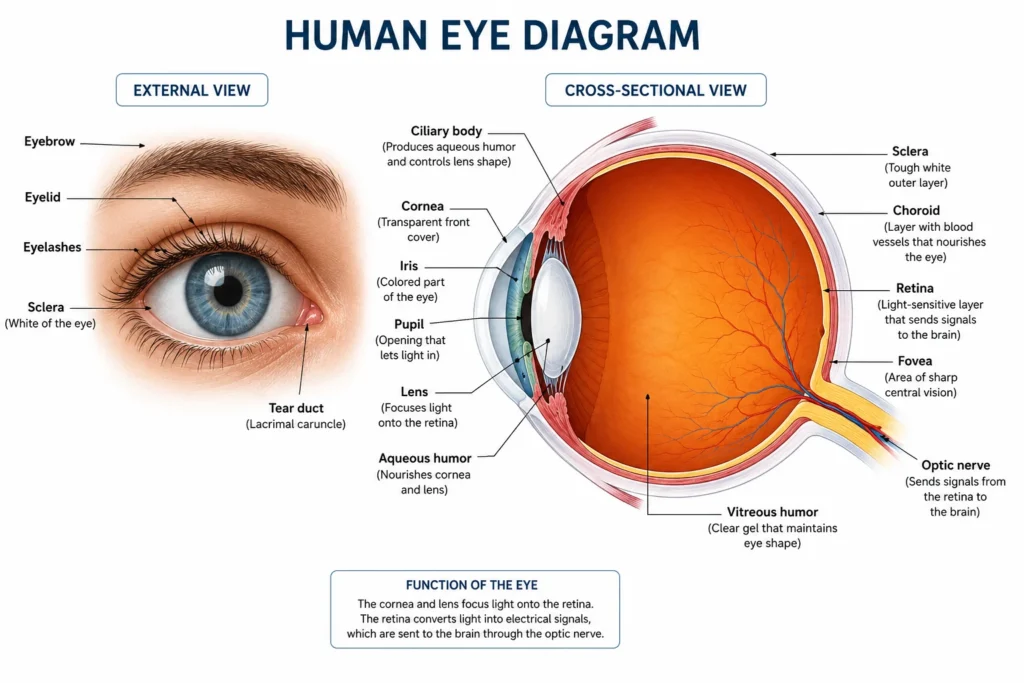
Below is a simple representation of the human eye structure:
The human eye consists of several parts, and each part performs a specific function.
Cornea
This is the clear surface, dome-shaped outermost layer which covers the eye. The cornea permits light rays to pass into the eye and focuses the light rays on the lens.
Functions:
It acts as a clear, transparent outer covering of the eye.
It helps to focus and bend incoming onto the lens.
Iris
The iris is the thin, colored ring of muscle tissue in the eye that regulates how much light enters the pupil. It determines eye color based on the amount of pigment (melanin).
Function:
It controls the entry of light in the eye.
Pupil
The pupil is an opening located in the center of the iris that allows light to enter the retina.
Function:
It regulates the amount of light entering the eye.
It improves the visual acuity because it prevents the irregular reflection by the periphery of the cornea and lens.
Eye Lens
It is an important part of the eye’s anatomy that allows the eye to focus on objects at varying distances. The lens is a transparent structure located behind the pupil.
Function:
It focuses light on the retina
It enables us to view both far and near things
The lens changes its shape in a process known as accommodation.
Retina
It is the innermost layer located at the back of the eye that converts light into electrical signals, allowing us for vision.
Function:
It changes light energy into electrical impulses
The rods allow us to see under low illumination, while cones enable color detection.
Optic Nerve
The optic nerve is a bundle of over one million nerve fibers that transmits visual information from the retina to the brain, basically it joins the eye with the brain.
Function:
Transfers information from the retina to the brain
Vitreous Humor
It is the clear, gel-like substance that fills the large space between the lens and the retina.
Function:
It Shapes and supports the retina
How Does the Human Eye Work?
The human eye functions much like a high-tech camera. Light reflects off objects and enters the eye through the cornea, that’s how the vision process begins. The cornea refracts the rays so that they go to the pupil. The rays continue being focused by the lens to the retina.
The retina transforms the light rays to electrical impulses, which are transmitted to the brain via the optic nerve.
All of this occurs within a matter of seconds.
Importance of the Human Eye
The eye of a human helps:
In reading and writing
Distinguish between colors and shapes
Notice movement
Maintain body balance and coordination
Interpret the surroundings
With weak eyesight, one will find it hard to carry out various day-to-day activities.
Healthy Eye Care Tips:
Students should take proper care of their eyes, especially during long study hours and screen usage.
Maintain proper reading distance
Avoid excessive screen time
Eat foods rich in Vitamin A
Sleep properly
Wash eyes with clean water
Use proper lighting while studying
Conclusion
The eye is a very complicated but amazing sensory organ which enables human beings to perceive the marvels of life. Understanding knowledge regarding the structure and functions is essential for constructing a sound background of Biology. The study of various structures of the eye will assist students in comprehending visual functions and importance of protection of eyes.
Frequently Asked Questions (FAQs)
1. What is the main function of the human eye?
It is the principal function of the human eye to enable us to visualize things using light and signaling it to the brain.
2. What controls light in the eye?
The iris controls the amount of light entering the eye through adjustment of pupil’s size.
3. What is the role of the retina?
It transforms light into electric impulses that are then sent to the brain through the optic nerves.
4. Why is cornea important?
Your cornea is a vital protective layer of your eye. It’s part of the focusingand keeps out things that don’t belong in your eyes.
5. What is the role of the eye lens?
It refracts and focuses incoming light onto the retina. Its main functions include image focusing, accommodation & UV filtration.