Difference Between Singular and Plural Words

    Book Your Free Demo Now!

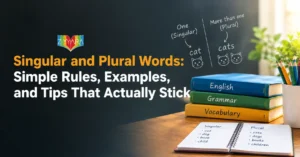
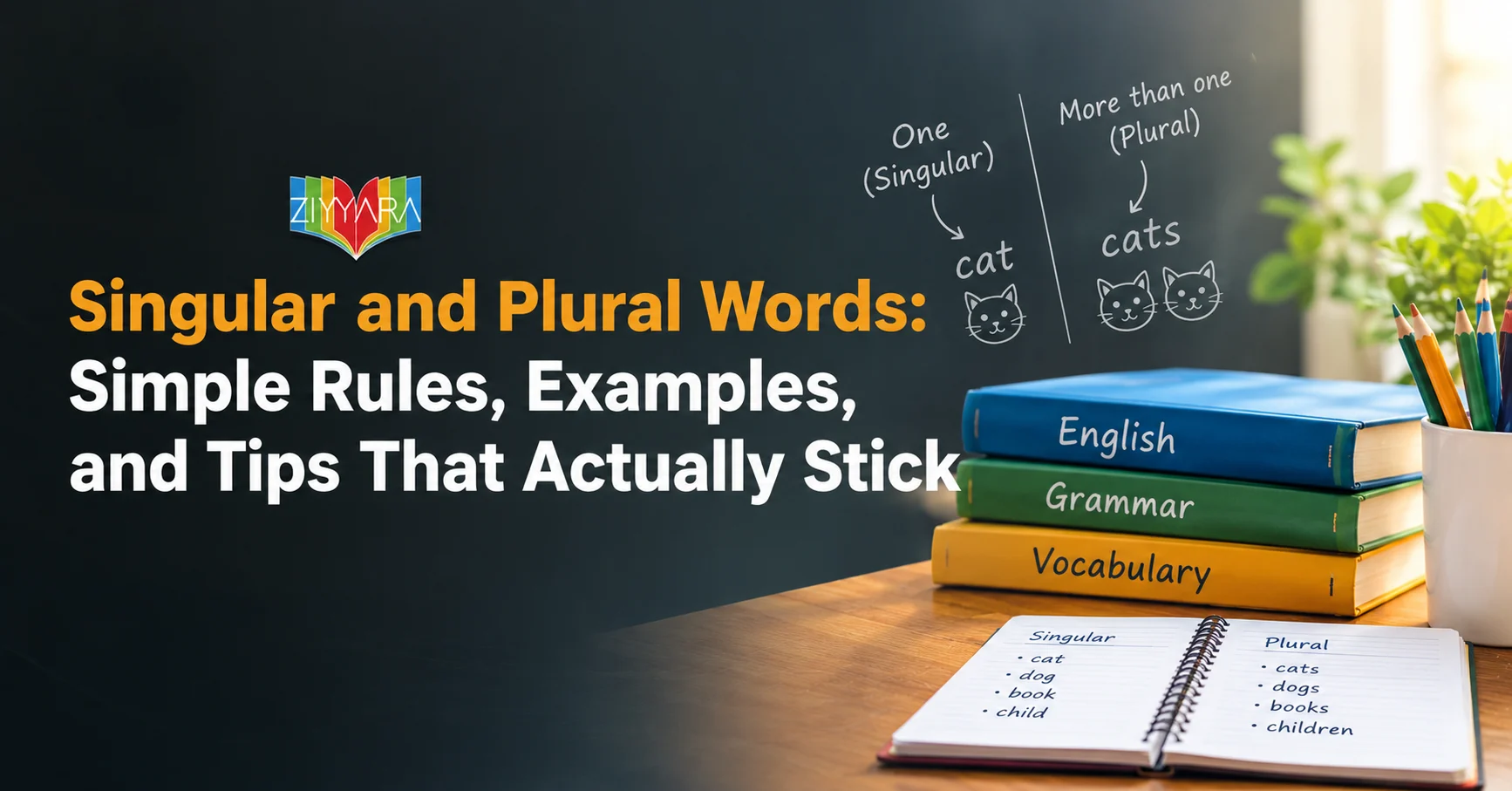
      Singular and Plural Words: Simple Rules, Examples, and Tips That Actually Stick

      Think about how often you say “one book” or “three books” in a day. Singular and plural words are so much a part of everyday speech that we rarely stop to think about them. For children learning English, though, this is one of the first grammar ideas that really matters, because it changes how they speak, write, and build sentences.

      Most plurals are easy. A handful are tricky, and those are the ones that trip kids up. Here’s a friendly walkthrough of the rules, the exceptions, and a few ways to practise without it feeling like homework.

      What Are Singular Words?

      A singular word names just one person, animal, place, or thing. If you’re talking about a single item, you’re using a singular noun.

      Some quick examples: a boy, a girl, an apple, a school, a dog, a pencil.

      You can spot them in everyday sentences too:

      • The boy is playing outside.
      • I have a red pencil.
      • A bird is sitting on the tree.
      • My friend lives in Delhi.
      • The cat is sleeping on the sofa.

      Singular nouns often come with little helper words like “a,” “an,” “one,” “this,” and “that,” as in “a book,” “an orange,” “this chair,” or “that house.”

      What Are Plural Words?

      A plural word names two or more of something. Whenever you’re talking about a group or a bunch of things, you need a plural.

      Boys, girls, apples, schools, dogs, pencils: you get the idea. Here they are in sentences:

      • The boys are playing outside.
      • I have three pencils.
      • Birds are sitting on the tree.
      • My friends live in Delhi.
      • The cats are sleeping on the sofa.

      Plurals usually travel with numbers bigger than one, or with words like “many,” “some,” “these,” and “those.” So we say “five books,” “many students,” “these chairs,” and “those houses.”

      LET LEARNING COME TO YOU

      Top Tutors. One-on-One. Right at Your Home.

      Book Your Free Demo Today

      Practice Worksheet: Singular and Plural Words

      Test your understanding with these simple exercises.

      A. Change these singular words into plurals.

      1. Book → __________
      2. Baby → __________
      3. Box → __________
      4. Child → __________
      5. Leaf → __________

      B. Choose the correct word.

      1. Two (cat / cats) are playing in the garden.
      2. I have three (pencil / pencils).
      3. Five (child / children) are reading books.
      4. The (baby / babies) are sleeping.
      5. Two (sheep / sheeps) are eating grass.

      C. Fill in the blanks with the correct form.

      1. One dog, two __________.
      2. One tooth, many __________.
      3. One bus, three __________.
      4. One mouse, two __________.
      5. One story, four __________.

      Answer Key

      1. 1. Books 2. Babies 3. Boxes 4. Children 5. Leaves
      2. 1. Cats 2. Pencils 3. Children 4. Babies 5. Sheep
      3. 1. Dogs 2. Teeth 3. Buses 4. Mice 5. Stories

      Singular vs Plural at a Glance

      The big difference is simply how many things you’re talking about. But the change doesn’t stop at the noun. It also affects the words around it, especially the verb.

      Singular

      Plural

      Means one

      Means two or more

      book

      books

      child

      children

      mango

      mangoes

      Usually goes with “is”

      Usually goes with “are”

      The dog is happy.

      The dogs are happy.

      How to Turn Singular Words into Plurals

      Good news: most English nouns follow a few simple patterns. Learn these and you can handle the majority of words you’ll meet.

      1. Just add “-s”

      This is the easiest rule, and it works for most nouns.

      Singular

      Plural

      book

      books

      pen

      pens

      chair

      chairs

      apple

      apples

      toy

      toys

      cup

      cups

      • I have one book. I have four books.
      • The girl has a toy. The girls have many toys.

      2. Add “-es” after hissing and buzzing sounds

      If a word ends in -s, -ss, -sh, -ch, -x, or -z, adding just an “s” would be hard to say out loud. Try saying “busS” and “buses” and you’ll hear why. So we add “-es” instead.

      Singular

      Plural

      bus

      buses

      class

      classes

      dish

      dishes

      watch

      watches

      box

      boxes

      quiz

      quizzes

      • The bus is yellow. The buses are yellow.
      • I have one box. I have three boxes.

      A small bonus: many words ending in -o also take “-es,” like mango → mangoes, potato → potatoes, and tomato → tomatoes. A few, such as photo → photos and piano → pianos, only take “-s,” so these are worth learning one by one.

      3. Swap “-y” for “-ies”

      When a word ends in a consonant followed by “y,” drop the “y” and add “-ies.”

      Singular

      Plural

      baby

      babies

      city

      cities

      story

      stories

      lady

      ladies

      puppy

      puppies

      • The baby is sleeping. The babies are sleeping.
      • I read a story. I read two stories.

      Watch out: if there’s a vowel before the “y,” just add “-s.” That’s why boy becomes boys, toy becomes toys, and key becomes keys.

      4. Change “-f” or “-fe” to “-ves” (sometimes)

      Some words ending in “-f” or “-fe” switch to “-ves” in the plural.

      Singular

      Plural

      leaf

      leaves

      wolf

      wolves

      knife

      knives

      wife

      wives

      life

      lives

      • A leaf fell from the tree. Many leaves fell from the tree.

      Here’s the catch: not every “-f” word plays along. Roof becomes roofs and chief becomes chiefs, so it’s best to learn these through reading and practice.

      5. Some words change completely

      These are the rebels. They ignore the usual rules and have their own special plural forms.

      Singular

      Plural

      man

      men

      woman

      women

      child

      children

      foot

      feet

      tooth

      teeth

      mouse

      mice

      person

      people

      • One child is reading. Three children are reading.
      • My tooth hurts. My teeth are healthy.

      There’s no shortcut here. The more your child reads, listens, and speaks, the more natural these will feel.

      6. Some words never change

      A few nouns look exactly the same whether there’s one or many.

      Singular

      Plural

      sheep

      sheep

      deer

      deer

      fish

      fish

      aircraft

      aircraft

      • One sheep is eating grass. Five sheep are eating grass.
      • I saw a deer. I saw two deer.

      So how do you tell the difference? Look at the clues around the word, like the number and the verb.

      Common Mistakes (and How to Fix Them)

      Almost every learner makes these slips at some point, and that’s completely normal. Here are the usual suspects:

      • ❌ Two childs → ✅ Two children
      • ❌ Three boxs → ✅ Three boxes
      • ❌ Many citys → ✅ Many cities
      • ❌ Five sheeps → ✅ Five sheep
      • ❌ These book is new → ✅ These books are new

      That last one is worth remembering. When the noun is plural, the verb usually needs to match. “The bird is flying” becomes “The birds are flying.”

      Fun Ways to Practise at Home

      You don’t need worksheets or special equipment. A few simple games are enough:

      1. Spot the picture: Show a picture of one apple and another of a pile of apples. Ask your child to name each one correctly.
      2. Count around the house: Count pencils, toys, or spoons together, saying “one spoon, two spoons” out loud.
      3. Match the cards: Write singular words on one set of cards and plurals on another, then match the pairs like a memory game.
      4. Write mini sentences: Try pairs like “One cat is sleeping” and “Two cats are sleeping.”
      5. Hunt while reading: During story time, challenge your child to find singular and plural nouns on the page.

      A little practice every day goes a long way. Soon your child will start noticing the patterns without being told.

      Final Thoughts

      Singular means one, plural means more than one. That’s the heart of it. Most plurals just need an “-s” or “-es,” some need a small spelling change, and a few irregular ones simply have to be remembered.

      With plenty of reading, a few quick games, and some patience, children pick these rules up faster than you’d expect. Before long, they’ll be using singular and plural words correctly in their conversations and their writing, without even thinking about it.

      Like? Share it with your friends

      Related Links

      Leave a Reply

      Your email address will not be published. Required fields are marked *