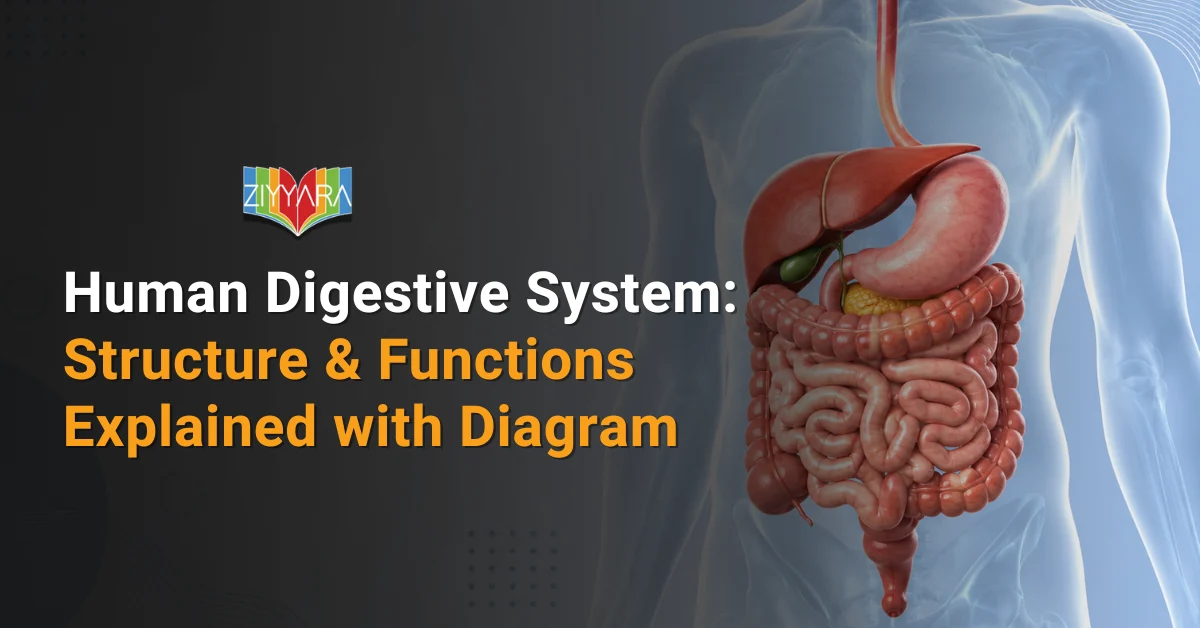
Human Digestive System: Structure & Functions Explained with Diagram
The human digestive system is essential because as everyone knows it helps transform our food into nutrients that provide us with energy, growth, and repair of body tissues. If you want to know more about its anatomy, physiology, or digestion then you’ve come to the right place!
Here, we’ll cover the roles of each organ in the digestive system, spell out the steps of digestion, and show how important every part is.
Introduction to the Human Digestive System
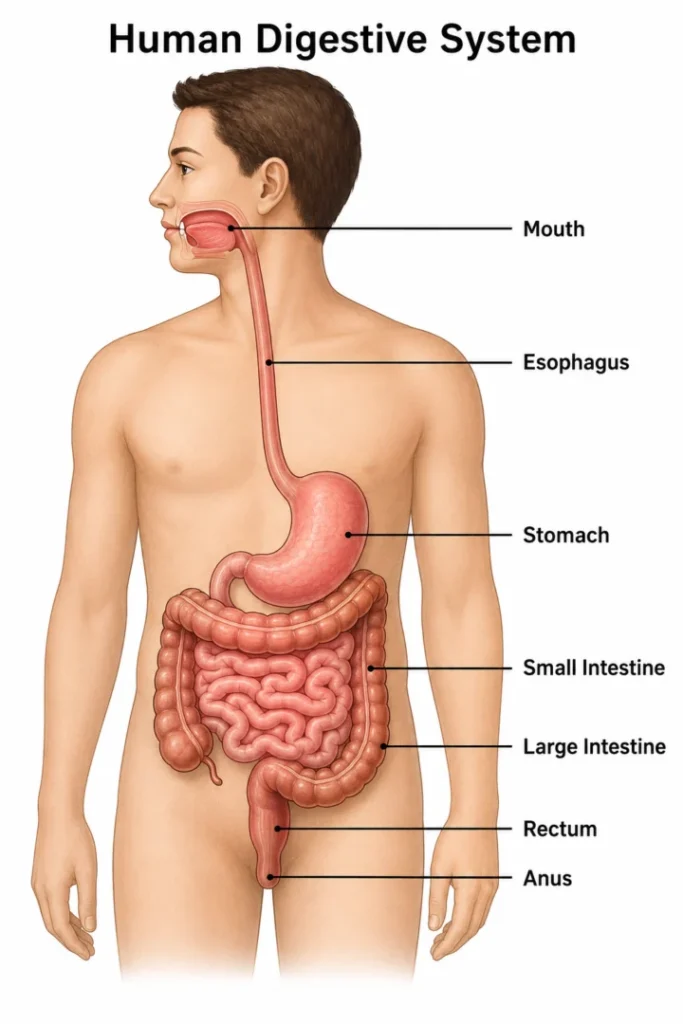
The structure of the human digestive system is composed of an elongated tubular organ called the alimentary canal plus several accessory ORGANS. The primary purpose of the digestive system is to transform complex foods into simple-soluble forms so that these simple-soluble materials can be absorbed by our blood.
Let’s explore in detail –
Structure of Human Digestive System
The digestive system is divided into two main parts:
1. Alimentary Canal Organs
These are the primary organs where food passes through:
Mouth – he digestive process starts in the mouth by mechanical breakdown by chewing the food with the help of teeth and also with the help of chemical breakdown with the help of enzymes found in saliva, which chemically break down the food.
Esophagus – It is a muscular tube through which food passes from the mouth to the stomach by peristalsis.
Stomach – It is an irregularly shaped organ that produces gastric juices having acids and enzymes to break down proteins.
Small Intestine – It is the primary location where most of the digestion and absorption takes place.
Large Intestine – It absorbs water and forms waste.
Rectum and Anus – Responsible for elimination of waste.
These organs help in digestion but food does not pass through them:
Salivary Glands – Saliva production for chemical digestion.
Liver – Bile juice production for fat digestion.
Gallbladder – Storage and release of bile juice in the small intestine.
Pancreas – Enzyme release in the small intestine for digesting carbohydrates, proteins, and fats.
Functions of Human Digestive System
If you are searching for “main functions of digestive system”, here are the five key functions:
1. Ingestion
Process of consuming food.
2. Digestion
The process by which foods are broken down to their simplest form consisting of:
a) Mechanical Digestion (by mastication and blending)
b) Chemical Digestion (by use of enzymes and acids).
3. Absorption
The process of absorption of nutrients into the bloodstream. This mainly takes place in the small intestine using finger-like projections known as villi.
4. Assimilation
Use of absorbed nutrients by the body cells.
5. Egestion
Elimination of undigested food.
Process of Digestion Step by Step
Complete digestion process in humans” are common search words among many students.
Here is an explanation:
The food is first broken down by mixing with saliva in the mouth.
It passes through the esophagus and arrives in the stomach.
In the stomach, proteins are partially digested.
Digestion is completed by bile and enzymes in the small intestines.
Nutrients are absorbed into the blood stream.
The waste is excreted from the large intestine.
These series of steps guarantee the supply of essential nutrients such as glucose, amino acids, fatty acids, vitamins, and minerals to our bodies.
Important Enzymes in Human Digestive System
Understanding digestive enzymes and their functions is important:
Amylase – Converts starch to sugars.
Pepsin – Digs up proteins in the stomach.
Lipase – Breaks down fat into fatty acids and glycerol.
Trypsin – Assists in protein digestion.
The function of these enzymes makes digestion easy and smooth.
Why the Digestive System Is Important
The significance of having a properly functioning digestive system cannot be overlooked. This is because;
Nutrient absorption will not take place.
Energy production becomes reduced.
Immunological system function is reduced.
Development of digestive problems takes place.
Proper digestion requires having a proper diet, adequate water intake, and eating dietary fibers.
Conclusion
In relation to the functioning of the human digestive system, there is an organization in terms of how the organs function and their structures to ensure that food is converted into energy. There are different organs in the digestive system whose functions are unique. Knowledge about the digestive system will help students score higher marks in exams.