El Niño and La Niña Explained: How They Influence India’s Weather
Have you ever thought about why there are years that receive more rainfall than the usual amount in India and vice versa? The relationship between the Pacific Ocean and the atmosphere, as well as two climate cycles called El Niño and La Niña, plays an essential role in such variations.
Learning about El Niño and La Niña will allow students to understand several terms they come across during their studies of Geography, Environmental Science, and Earth Science. However, what is even more interesting is that they will understand how distant events can affect India’s weather.
What Are El Niño and La Niña?
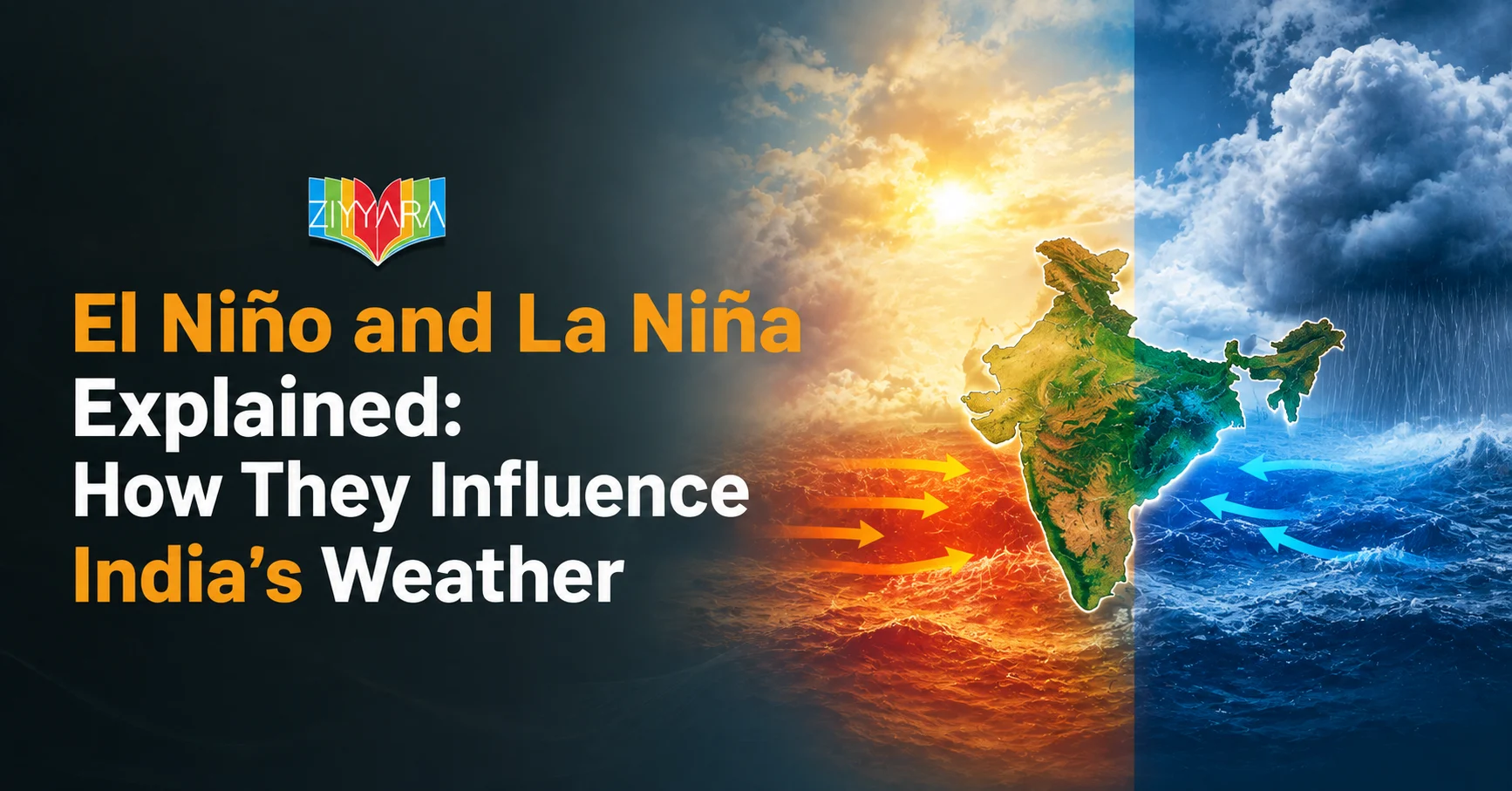
El Niño and La Niña are two extreme phases of a climate event called ENSO or El Niño Southern Oscillation where there is change in sea surface temperature and atmospheric conditions in the tropical region of the Pacific Ocean.
El Niño – The tropical central and eastern Pacific Ocean is warmer than normal.
La Niña – The same area is cooler than normal.
Neutral stage – The condition neither represents El Niño nor La Niña.
The changes might have an impact on atmospheric circulation and ultimately on the weather in different regions of the world, including India.
How Does El Niño Affect India’s Weather?
For many years, El Niño has been connected to weak Indian summer monsoons; however, the impacts may vary each year.
During years of El Niño, temperature changes may occur in the Pacific Ocean; consequently, the circulation of air will change. As a result, there might be a weak monsoon in India.
The impacts might be:
Reduced rainfall in some parts of India
Conditions resembling drought
Heat stress due to higher temperatures
Increased pressure on agriculture and water sources
It is important to point out that El Niño does not always cause weak monsoon in India each year. There may be other factors that would determine precipitation in India.
La Niña often correlates with a stronger Indian summer monsoon and heavy rainfall in several regions of India.
In La Niña, cooler than usual temperatures in the Pacific Ocean bring about atmospheric conditions which help to strengthen monsoon circulation.
It may result in:
There are high levels of precipitation in some areas
High chances of rainfall
Higher chances of flooding in some areas
Climate changes
It has been said before that La Niña is just one of the many factors that affect the weather in India.
El Niño vs La Niña: What's the Difference?
Feature
El Niño
La Niña
Pacific Ocean
Warmer than normal
Cooler than normal
Indian Monsoon
Often weaker
Often stronger
Rainfall in India
Can be below normal
Can be above normal
Major Concern
Drought and heat
Heavy rainfall and flooding
The relationship isn’t completely predictable, but understanding these patterns helps scientists improve seasonal climate forecasts.
Why Does the Pacific Ocean Affect India?
It may be surprising to you, but how does an ocean which lies thousands of kilometers away affect the monsoons of India?
The answer is the relation between the ocean and the atmosphere.
The changes in temperatures of the Pacific Ocean may cause changes in the pressure, winds, convection, and circulation pattern of the atmosphere. All these changes can move through the atmosphere to affect other regions outside the Pacific.
Therefore, climate is a system which affects everywhere else on Earth.
How Do El Niño and La Niña Affect Students and Everyday Life?
Climate patterns aren’t only textbook theories. Weather patterns can have an impact on your daily life.
For example:
It may become necessary for farmers to revise their planting schedule.
The availability of water may depend on the amount of precipitation.
Heatwaves may affect your health as well as outdoor activities.
The rainfall will increase the probability of flooding.
Costs of food may depend on agriculture.
In turn, this helps students comprehend how these lessons are related to real-life events.
How Can Students Learn Climate Concepts More Effectively?
Climate issues tend to be difficult at times because they include oceans, circulation of the atmosphere, temperature, pressure, and weather phenomena all at once.
A good way of grasping such issues would be:
Start with understanding the basics of weather and climate.
Understand the part played by oceans and atmosphere in climate.
Visualize El Niño and La Niña using diagrams.
Link the concepts to practical examples in India.
Re-explain the concept using your own words.
Ask questions where you do not understand an issue instead of memorizing it.
Make Climate Science Easier to Understand With Ziyyara
Climate knowledge is not only about memorizing definitions; it’s more about knowing the reasons behind events and relationships between various parts of our world.
No matter whether your kid requires help with Geography, Science, Environmental Studies, or any kind of examination preparation, personal assistance, our tutors will enable him/her to comprehend complex topics.
If you are looking for personalized online tutoring for your child, then visit Ziyyara Edutech to clear your kid’s concepts.