The map work is the only component in the Social Science examination where you cannot write your way out of any mistake. Either you will place the mark on the correct place or you won’t. This is precisely the reason why it is the simplest area to master.
In the CBSE class 10 examinations, the marks for the map work section are 5 out of the total 80. 2 marks can be scored from history and 3 marks from Geography. The majority of the students ignore this section while attempting the paper and end up losing one or two marks without realizing it. This blog explains all the pointers that are required for the geography map work section.
What is the weightage of map work in Class 10 Social Science?
Five marks. At present, five questions with one mark each: two based on maps in history and three based on maps in geography. Total marks in the paper are 80, which makes map work a tiny proportion of the paper. Yet it is a very black-and-white proportion. If a student has prepared well, he/she can be sure of getting all five.
Now contrast it with a five mark answer where even an excellent student may end up scoring three and a half.
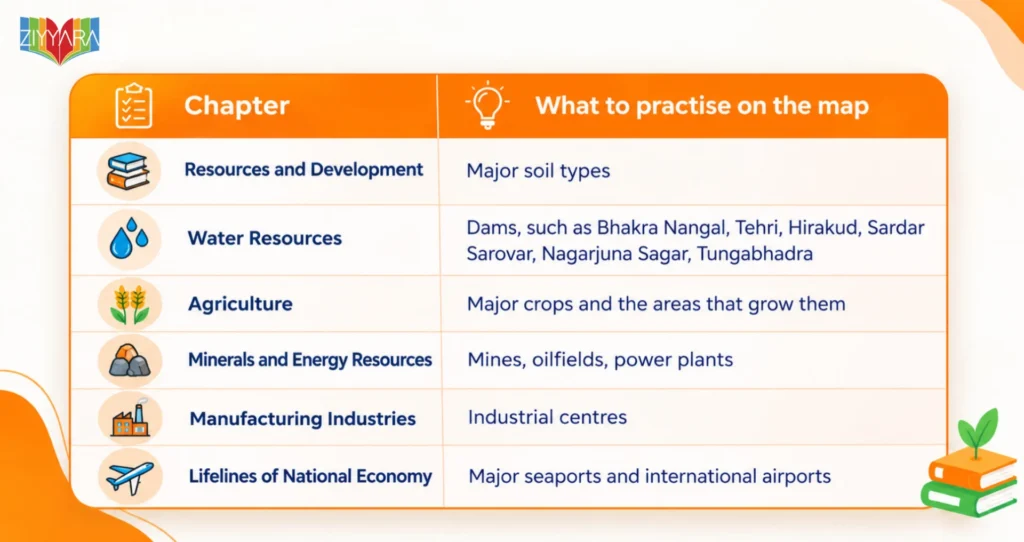
The items come from the NCERT book Contemporary India II. You will be asked to identify a feature from a description, or to locate and label it on an outline map of India. The questions draw on these chapters:
The exact list changes slightly from year to year, so always check the current official CBSE map list for your session before you start. Print it and keep it next to your outline maps.
Why do students lose marks in their map work?
It is rarely ever due to a lack of knowing the answer. There are normally four mistakes.
Students only study from the textbook map. This is a large, coloured and labelled map. On the other hand, the exam map is very small and blank. Being able to recognise the dam in the textbook does not equate to identifying it on the blank map.
Marking it in the correct region but the wrong location. The dot could be just slightly inland and this makes it become a completely different place this is especially the case with ports and cities.
Being unable to distinguish between similar features. Confusion sets in when students try to distinguish between two dams or two ports close to each other.
They only start revising in the final month. Map work needs repetition, not cramming. Ten minutes a day for four weeks beats three hours the night before.
How can you practise geography map work so it sticks?
In order for students to gain practice in using maps in geography, they should be given blank outline maps.
Attach each point to something that you can visualize. Do not learn that “Kandla is in Gujarat.” Attach it: it lies right above on the west coast within the Gulf of Kutch. Rivers, state boundaries, and coastline should be the reference points. If you know how an area sits in relation to two other areas, you will get it correct even under pressure.
Group study rather than list study. Learn the entire west coast ports first, then all the east coast ports. Learn all the dams along each river. Your mind learns neighbourhoods much better than 20 unrelated dots.
Test yourself blind. Get a blank map, close the book, and label everything you can recall from memory. And then check. Items that you could not remember are really the syllabus for the next day.
Do the neighbour check. Always before you finalize a mark, check what lies around it north, south, east and west. If your answer is not related to the neighbours, shift the mark.
Time yourself near the end. After getting the accuracy, practice the entire five-point question in a few minutes, just the way you would do in the examination hall.
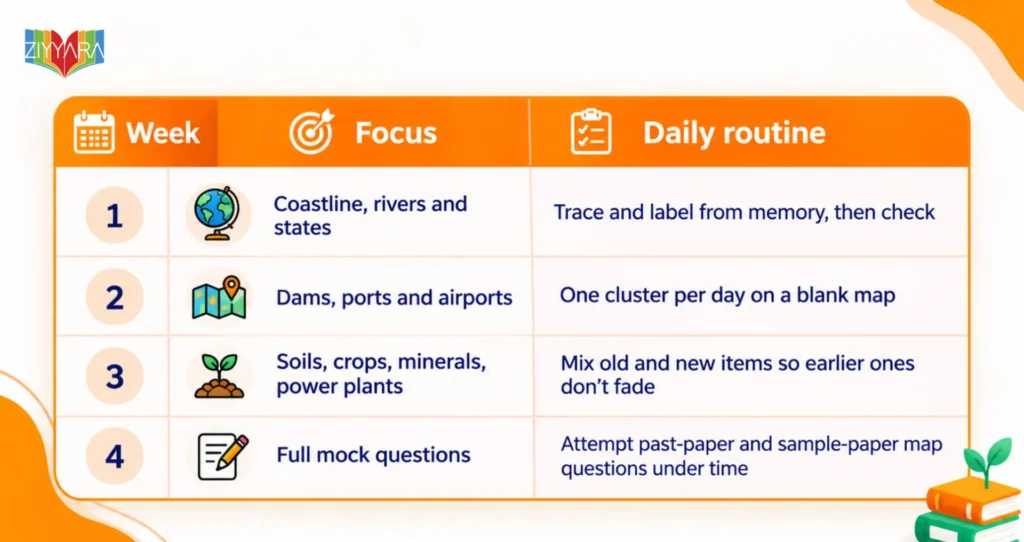
What is a good 4-week plan for map work?
Ten minutes a day is enough. Adjust the pace if your board exam is closer.
Use the official CBSE sample papers for your final week. They show the exact style of question you will face.
What do you do during the exam?
Check each map instruction twice. Some map questions will ask you to identify an object, some to locate it and label. Mistaking one for another means you lose a mark for something you knew.
Make sure that your marks and labels are neat and small. A poorly drawn mark is often read as an incorrect one.
Do your map questions calmly, don’t leave them till the end when you’re in a rush, having only two minutes to go.
If you’re unsure about the answer, apply the neighbour check technique once again before proceeding.
How can Ziyyara assist in geography map tasks?
Map tasks are those kinds of tasks where a tutor may correct your mistake in seconds, and you would otherwise struggle with it for weeks by yourself. In one-to-one tutoring classes, a tutor watches you locate each object on the map, catches the errors right away and creates your next practice assignment based on the mistakes.
Frequently asked questions
1.How many marks is map work in CBSE Class 10 Social Science?
Five marks out of 80. Two come from history and three from geography, with one mark per item in the current pattern.
2.Which geography chapters are asked in map work?
The items come from Contemporary India II, mainly soils, dams, crops, minerals and power plants, industrial centres, and ports and airports. Check the official CBSE map list for your session.
3.How long does it take to prepare for map work?
About four weeks at ten minutes a day is enough for most students. Starting earlier makes it easier.
4.Do I need to practise on blank outline maps?
Yes. Studying only from the textbook map makes recognition feel easy, but the exam gives you an empty outline. Practising on blank maps is the single most useful habit.
5.Is map work the same for ICSE and state boards?
No. The marks, format and item lists differ by board. Check your own board’s syllabus and sample papers.
6.Can I really score full marks in map work?
Yes. Unlike long answers, map items have a clear right answer, so consistent practice can realistically get you all five marks.