Photosynthesis Explained: Process, Equation, Diagram, and Importance
Have you ever wondered how plants produce their food in situations where there was no kitchen available to them? While human beings and other animals seek food to consume, plants use the energy from sunlight, water, and carbon dioxide to create their food via the process of photosynthesis.
This is probably one of the most important processes of biology because it produces food and oxygen for the survival of various organisms. Through photosynthesis, students can learn more about plant development.
What Is Photosynthesis?
It is the process in which water and carbon dioxide are used to produce glucose and oxygen with the assistance of sunlight to make an organic compound.
Photosynthesis is the process by which plants produce their own food with the help of energy from sunlight and an easy-to-understand language.
Quick Definition
“Photosynthesis is a “biological process by which green plants produce food using sunlight, water, carbon dioxide and chlorophyll.”
This food provides energy for plant growth and development.
Why Is Photosynthesis Important?
Life on our planet would be impossible without photosynthesis.
This is why photosynthesis is vital:
It aids in the generation of oxygen we breathe!
It benefits plants with nutrition and consequently all the other organisms as well.
It is responsible for keeping the oxygen and carbon dioxide level balanced in our atmosphere.
It is helpful to maintain ecosystems and food chains.
It reduces CO2 emissions (causes global warming).
Did You Know?
Plants, algae and other organisms which conduct photosynthesis account for 50-80% of the oxygen in the Earth’s atmosphere.
Plants require four essential components to carry out photosynthesis:
1. Sunlight
Photosynthesis occurs mainly with the aid of energy from the sun.
2. Water
Plants take water into their bodies through their roots from the soil.
3. Carbon Dioxide
The third step is for the plants to absorb the carbon dioxide from the atmosphere through the stomata in their leaves.
4. Chlorophyll
This green colouring in plant leaves which absorbs the sunlight is called chlorophyll.
The Photosynthesis Chemical Equation
Photosynthesis can be illustrated using a chemical formula as follows:
6CO_2 + 6H_2O + Light\ Energy \rightarrow C_6H_{12}O_6 + 6O_2
What Does This Equation Mean?
Carbon dioxide + Water + Sunlight
Produces Glucose (food) + Oxygen
The glucose produced is utilized by the plant for energy, while the oxygen is released to the atmosphere.
How Does Photosynthesis Work?
Photosynthesis occurs mainly in the leaves of plants, and consists of the following parts:
Step 1: Absorption of Sunlight
The chlorophyll in leaves collects light and absorbs the sun’s energy.
Step 2: Uptake of Water
The roots gather water which is carried to the leaves.
Step 3: Intake of Carbon Dioxide
The leaves are the capturing organs for the CO2 and they capture the CO2 from the surroundings.
Step 4: Food Production
The light is used as an energy source to convert water and carbon dioxide into glucose.
Step 5: Release of Oxygen
This results in the production of oxygen.
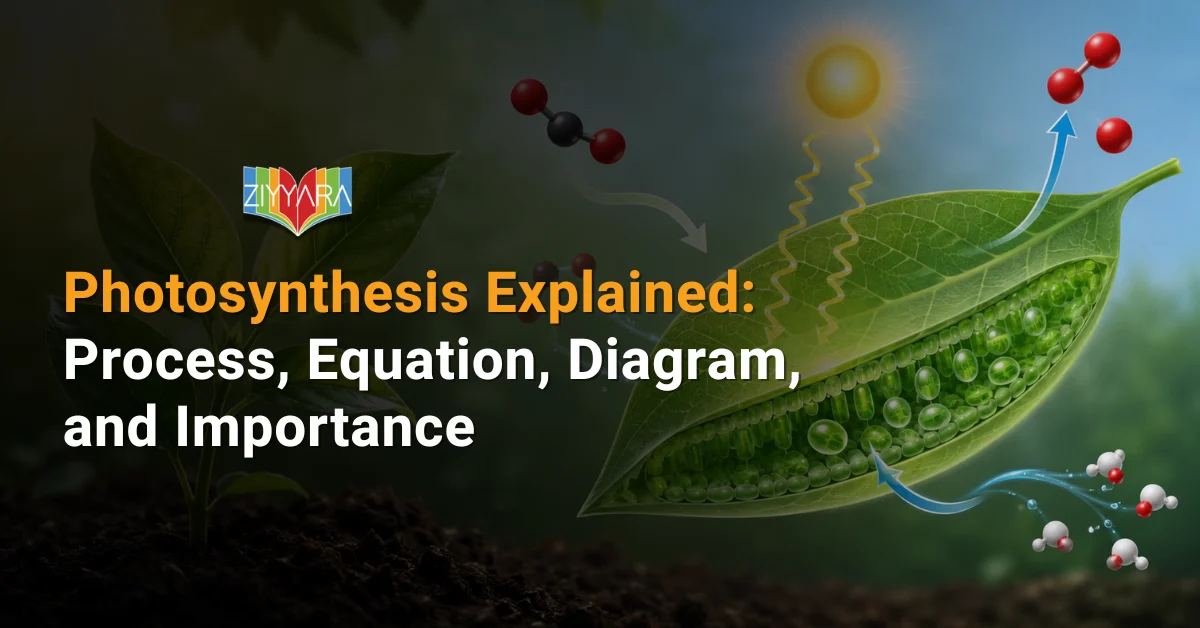
Photosynthesis Diagram
Students can understand the process better through a simple flow:
Sunlight
↓
Green Leaves (Chlorophyll)
↓
Carbon Dioxide + Water
↓
Photosynthesis
↓
Glucose (Food) + Oxygen
This diagram shows how sunlight, water, and carbon dioxide work together to help plants produce food.
Where Does Photosynthesis Take Place?
This process occurs inside small living things called chloroplasts, found mainly in the leaves of green plants.
These chloroplasts contain pigments like chlorophyll which help in absorbing energy from sunlight.
Factors Affecting Photosynthesis
Several factors influence the rate of photosynthesis:
Light Intensity
An increase in the amount of sunlight usually means increased photosynthesis.
Carbon Dioxide Concentration
An increase in carbon dioxide usually stimulates food production.
Water Availability
A shortage of water inhibits the process of photosynthesis.
Temperature
There is an optimum temperature range for photosynthesis to occur.
What Are the Products of Photosynthesis?
The products of photosynthesis are:
Glucose
Serves as food for the plant.
Provides energy for growth.
Can be stored as starch.
Oxygen
Released into the atmosphere.
Essential for respiration in humans and animals.
Photosynthesis and the Food Chain
Photosynthesis forms the basis of all food chains.
Plants are termed producers as they produce their own food. Herbivores rely on photosynthesis directly, while carnivores rely on it indirectly.
In the absence of photosynthesis:
No food will be available for the herbivores.
There will be other effects, too, on carnivores.
Ecosystems will no longer exist.
Difference Between Photosynthesis and Respiration
Photosynthesis
Respiration
Occurs in plants
Occurs in plants and animals
Uses sunlight
Does not require sunlight
Produces glucose
Breaks down glucose
Releases oxygen
Releases carbon dioxide
Stores energy
Releases energy
Understanding this difference helps students grasp how energy moves through living organisms.
Interesting Facts About Photosynthesis
The term autotroph is given to green plants because they produce their own food.
Photosynthesis occurs mostly during daytime.
Photosynthesis is done by algae in the ocean.
We owe our oxygen to the photosynthesis process.
Chlorophyll gives the green color to the plant body.
Frequently Asked Questions (FAQs)
What is photosynthesis in simple words?
Photosynthesis is the process through which plants manufacture their food using water, sunlight, carbon dioxide and produce oxygen.
What is the importance of photosynthesis?
Photosynthesis is vital as it forms food, oxygen and life on earth.
Where does photosynthesis take place?
Photosynthesis occurs within the plant cells, in structures known as chloroplasts.
What are the raw materials needed in photosynthesis?
The basic raw materials are water, carbon dioxide, sunlight, and chlorophyll.
What is the end product of photosynthesis?
Glucose is the basic output, which is used by plants as food.
Conclusion
Photosynthesis is a significant biological process which helps the plants in producing their food by using sunlight, water and carbon dioxide. Apart from providing energy to plants, it is responsible for supplying oxygen and energy to almost all life forms present in the world. This is the reason why learning about the photosynthesis process, its equation, and significance becomes crucial for the students.