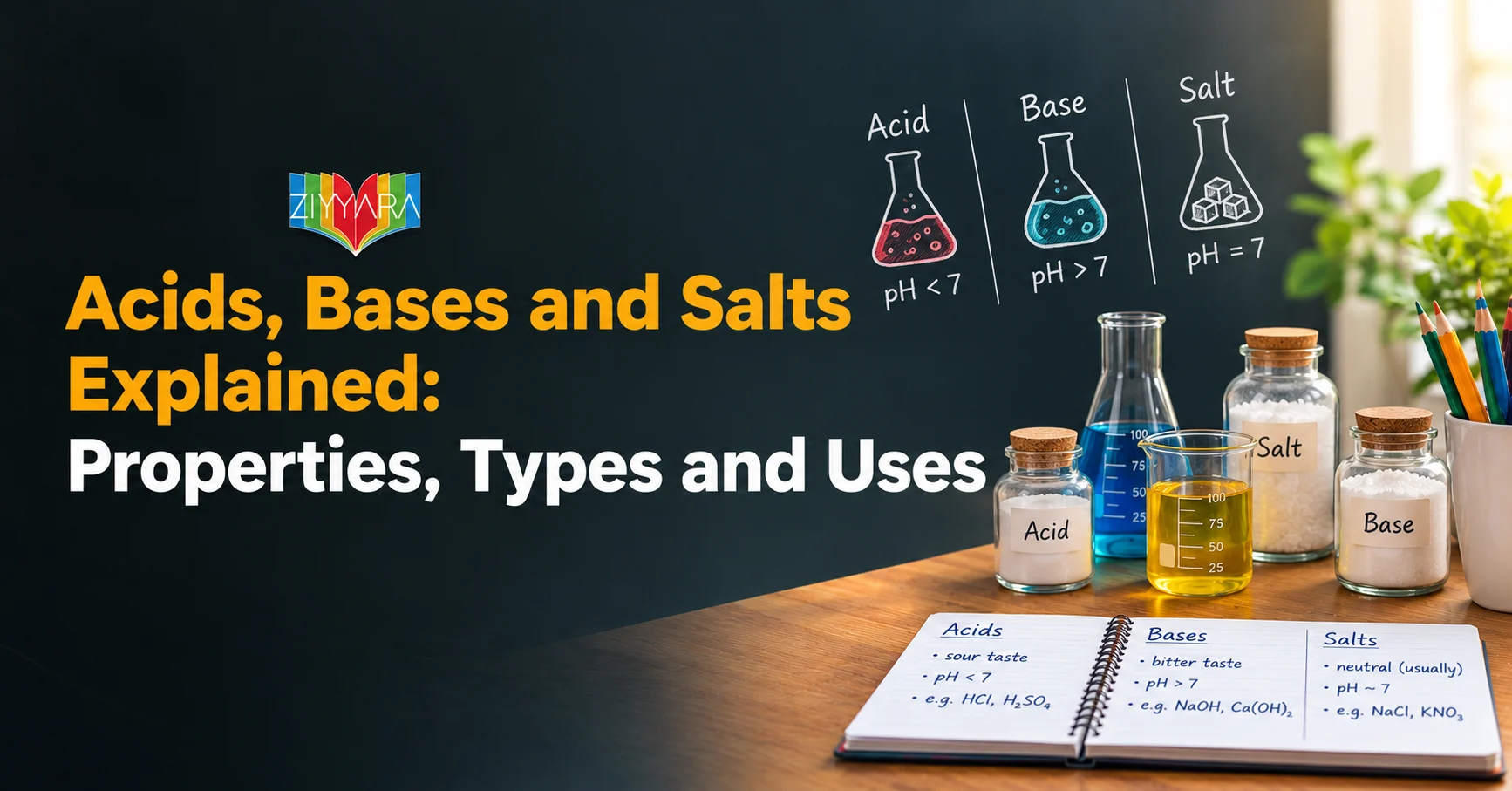
Acids, Bases and Salts Explained: Properties, Types and Uses
Learning chemistry gets easier when one understands how some of the substances used daily work. Right from the lemon juice that we drink and soap that we use while washing our hands, acids, bases, and salts are found everywhere. Such substances help in our daily activities and are an essential component of chemistry at the secondary level.
What is an acid? What is a base and salt? How are these different from one another and what happens when they interact? Let’s define these terms in a manner which is student-friendly.
What Are Acids, Bases and Salts?
Words?
Acids, bases, and salts are three major groups of chemicals. They can be distinguished by their chemical properties and actions.
1. What Are Acids?
Acids, Bases and Salts are three major classes of chemical substances. These can be classified according to their chemical characteristics and behavior.
Properties of acids:
They change blue litmus paper to red.
Their pH is less than 7.
They react with some metals to produce hydrogen gas.
They react with bases to produce salt and water.
Examples of acids:
Hydrochloric acid (HCl)
Sulphuric acid (H₂SO₄)
Acetic acid (CH₃COOH)
Citric acid (found in citrus fruits)
Uses of acids: Acids find their use in food preservation, fertilizer production, batteries, and many other fields.
2. What Are Bases?
Bases are compounds that can neutralize acids. Many bases form hydroxide ions (OH⁻) in water solution. Water-soluble bases are called alkalis.
Properties of bases:
These substances change red litmus paper to blue color.
Their pH values usually exceed 7.
These substances are slippery, but substances cannot be touched for identification purposes.
These substances react with acids and form salt and water.
Examples of bases:
Sodium hydroxide (NaOH)
Calcium hydroxide [Ca(OH)₂]
Magnesium hydroxide [Mg(OH)₂]
Ammonium hydroxide (NH₄OH)
Uses of bases: Bases are used in soap manufacturing, cleaning agents, paper, and certain antacids.
3. What Are Salts?
Salts are ion compounds that can be formed when an acid and a base react in a neutralisation process.
Properties of salts:
Salts are often crystalline solids.
They may dissolve readily in water, whereas others fail to do so.
Their pH is either acidic, basic or neutral.
Salts are conductors of electricity in the molten state or in aqueous solution, when their ions are free to move.
Examples of salts:
Sodium chloride (NaCl)
Copper sulphate (CuSO₄)
Sodium carbonate (Na₂CO₃)
Calcium carbonate (CaCO₃)
Uses of salts: Salt is used in cooking, agriculture, water purification, medicines, and many other manufacturing fields.
What Is the Difference Between Acids, Bases and Salts?
Property
Acids
Bases
Salts
pH value
Below 7
Above 7
Can vary
Litmus test
Blue to red
Red to blue
Depends on salt
Examples
HCl, H₂SO₄
NaOH, Ca(OH)₂
NaCl, CuSO₄
Common role
Chemical reactions
Neutralisation
Industrial and daily uses
What Is a Neutralisation Reaction?
A neutralisation reaction occurs when an acid reacts with a base to form salt and water.
General equation:
Acid + Base → Salt + Water
Example:
HCl + NaOH → NaCl + H₂O
Hydrochloric acid reacts with sodium hydroxide to form sodium chloride and water.
Such reactions are used in our everyday life, for example, neutralization of excessive acid in the stomach using antacids.
Why Should Students Learn About Acids, Bases and Salts?
The study of acids, bases, and salts will help the student:
Form a good grounding in chemistry.
Understand chemical reactions and chemical equations.
Relate theory to practice.
Perform well in academic and competitive exams.
Frequently Asked Questions (FAQs)
1. What is the main difference between acids and bases?
Acids release hydrogen ions when dissolved in water, while bases accept hydrogen ions or produce hydroxide ions when dissolved in water. Bases and acids show opposite characteristics during a litmus test.
2. What is the pH scale?
The pH scale shows whether an aqueous solution is acidic or basic. A value lower than seven is acidic, while a value greater than seven means a basic or alkali. Seven is a neutral value.
3. What happens when an acid reacts with a base?
Bases and acids react to produce salt and water through neutralization reactions.
4. Is common salt an acid or a base?
A common salt is one of the salts that results from the reaction between hydrochloric acid and sodium hydroxide. Common salt solution is normally neutral.
Make Chemistry Easier with Ziyyara’s Online Tutoring
Chemistry is a subject that does not have to be complex if the right explanations and practice are available.
Through the one-on-one online coaching provided by Ziyyara, you can help your child develop their knowledge of the subject in an effective way. Our online learning methodology can assist students in clearing any doubt they might have regarding fundamentals of the subject and in preparing for exams.
If your child requires assistance with grasping concepts of chemical reactions, solving equations or chemistry topics, we can definitely help them out.