Fractions Explained

    Book Your Free Demo Now!

      Fractions Explained: Types, Rules, Examples and How to Solve Them

      Fractions are an essential part of mathematics. They help us represent parts of a whole, compare quantities, and solve everyday problems involving numbers. From sharing a pizza to calculating measurements, fractions in maths are used in many real-life situations.

      In this guide, we’ll understand what are fractions, their different types, basic rules, operations, and practical examples.

      What Are Fractions?

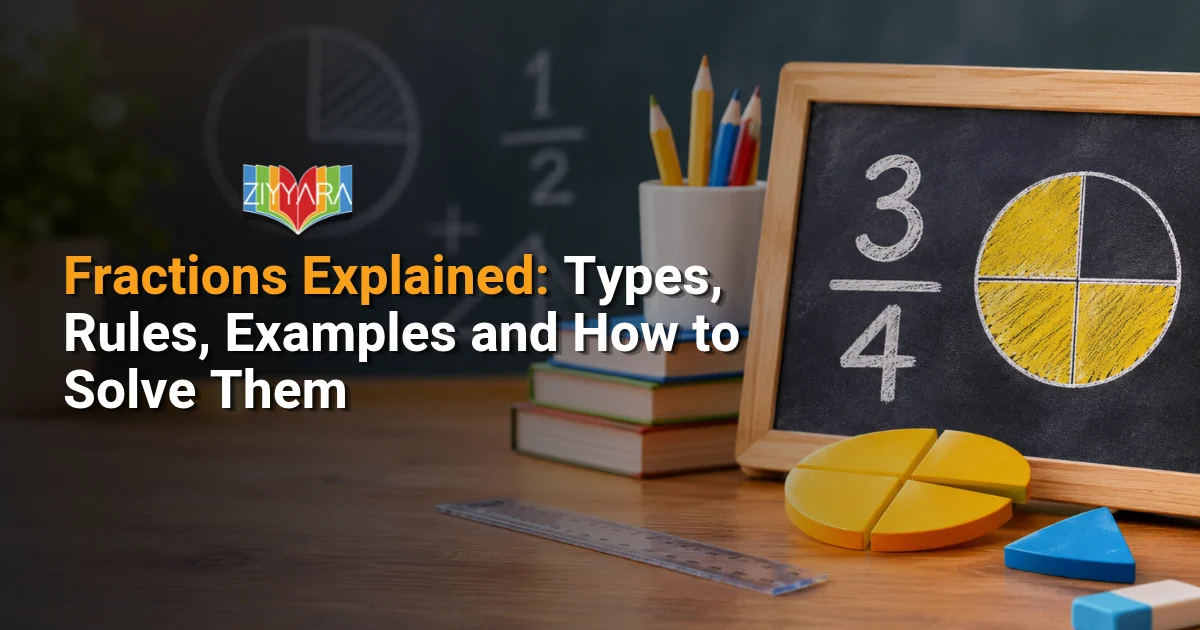
      A fraction represents a part of a whole or a part of a group. It is written using two numbers separated by a line.

      For example, 3/4 means three parts out of four equal parts.

      • Numerator: The top number (3)
      • Denominator: The bottom number (4)

      So, in 3/4, 3 is the numerator and 4 is the denominator.

      LET LEARNING COME TO YOU

      Top Tutors. One-on-One. Right at Your Home.

      Book Your Free Demo Today

      Parts of a Fraction

      Every fraction has two main parts:

      Numerator: Shows how many parts are being considered.

      Denominator: Shows the total number of equal parts.

      For example, in 5/8:

      • 5 = Numerator
      • 8 = Denominator

      The denominator should never be zero because division by zero is undefined.

      Types of Fractions

      Learning the types of fractions makes it easier to understand and work with them.

      1. Proper Fractions

      A proper fraction has a numerator smaller than its denominator.

      Examples: 2/5, 3/7, 5/9

      Its value is always less than 1.

      2. Improper Fractions

      An improper fraction has a numerator equal to or greater than its denominator.

      Examples: 7/4, 9/5, 8/8

      Its value is equal to or greater than 1.

      3. Mixed Fractions

      A mixed fraction contains a whole number and a proper fraction.

      Examples: 2 ½, 4 ⅓, 5 ¾

      An improper fraction can be converted into a mixed fraction.

      4. Like Fractions

      Like fractions have the same denominator.

      Examples: 2/9, 5/9, 7/9

      They are easy to add or subtract because their denominators are already the same.

      5. Unlike Fractions

      Unlike fractions have different denominators.

      Examples: 2/3, 3/5, 4/7

      You usually need to find a common denominator before adding or subtracting them.

      6. Equivalent Fractions

      Equivalent fractions have different numerators and denominators but represent the same value.

      Examples: 1/2 = 2/4 = 4/8

      Multiplying or dividing both the numerator and denominator by the same non-zero number produces an equivalent fraction.

      Rules of Fractions

      Understanding the basic rules of fractions helps you solve fraction problems accurately.

      • To add or subtract fractions, use a common denominator.
      • When multiplying fractions, multiply the numerators and denominators directly.
      • To divide fractions, multiply the first fraction by the reciprocal of the second.
      • Always simplify the final answer whenever possible.
      • Never use zero as a denominator.

      How to Add Fractions

      When denominators are the same

      Add the numerators and keep the denominator unchanged.

      Example:

      2/7 + 3/7 = 5/7

      When denominators are different

      Find the least common denominator, convert the fractions, and then add them.

      Example:

      1/2 + 1/4
      = 2/4 + 1/4
      = 3/4

      How to Subtract Fractions

      For fractions with the same denominator, subtract the numerators and keep the denominator.

      Example:

      5/8 − 2/8 = 3/8

      For different denominators, first find a common denominator.

      Example:

      3/4 − 1/2
      = 3/4 − 2/4
      = 1/4

      How to Multiply Fractions

      Multiply the numerators together and the denominators together. Then simplify the answer.

      Example:

      2/3 × 4/5
      = 8/15

      So, the answer is 8/15.

      How to Divide Fractions

      To divide fractions, keep the first fraction, change division to multiplication, and flip the second fraction.

      Example:

      2/3 ÷ 4/5
      = 2/3 × 5/4
      = 10/12
      = 5/6

      This method is often called Keep, Change, Flip.

      Fractions with Examples

      Here are some quick fractions with examples to make the concepts easier to understand:

      Operation

      Example

      Answer

      Addition

      1/4 + 2/4

      3/4

      Subtraction

      5/6 − 2/6

      1/2

      Multiplication

      2/3 × 3/4

      1/2

      Division

      3/4 ÷ 2/5

      15/8

      Common Mistakes Students Make

      Students often make these mistakes while working with fractions:

      • Adding denominators directly: 1/3 + 1/3 ≠ 2/6
      • Forgetting to find a common denominator.
      • Not simplifying the final answer.
      • Forgetting to take the reciprocal when dividing fractions.
      • Confusing mixed fractions with improper fractions.
      • Treating the numerator and denominator as separate whole numbers during multiplication or division.

      Carefully following each step can help avoid these errors.

      Tips to Learn Fractions Easily

      If you’re wondering how to solve fractions confidently, regular practice is the key.

      • Start with simple fractions before moving to complex problems.
      • Learn the difference between each type of fraction.
      • Practice addition, subtraction, multiplication, and division separately.
      • Use visual examples such as pizzas, chocolate bars, or number lines.
      • Always simplify your answers.
      • Solve a few fraction problems every day.

      Frequently Asked Questions (FAQs)

      1. What is a fraction in maths?

      A fraction represents a part of a whole or a group. It consists of a numerator and a denominator. For example, 3/5 represents three parts out of five equal parts.

      2. What are the 4 types of fractions?

      The commonly taught types include proper, improper, mixed, like, unlike, and equivalent fractions. Proper, improper, mixed, and equivalent fractions are among the most commonly discussed categories.

      3. How do you add fractions?

      If the denominators are the same, add the numerators and keep the denominator unchanged. If they are different, first find a common denominator and then add the fractions.

      4. How do you subtract fractions?

      Find a common denominator if necessary, subtract the numerators, keep the denominator unchanged, and simplify the result.

      5. How do you multiply fractions?

      Multiply the numerators together and the denominators together. Then simplify the resulting fraction.

      6. How do you divide fractions?

      Multiply the first fraction by the reciprocal of the second fraction. For example, 1/2 ÷ 3/4 = 1/2 × 4/3 = 2/3.

      7. What is the difference between a proper and improper fraction?

      A proper fraction has a numerator smaller than its denominator, such as 3/5. An improper fraction has a numerator equal to or greater than its denominator, such as 7/5.

      8. How can students learn fractions easily?

      Students can learn fractions more effectively through regular practice, visual examples, number lines, and solving different types of fraction problems step by step. Understanding the basic rules first makes advanced problems much easier.

      Like? Share it with your friends

      Related Links

      Leave a Reply

      Your email address will not be published. Required fields are marked *