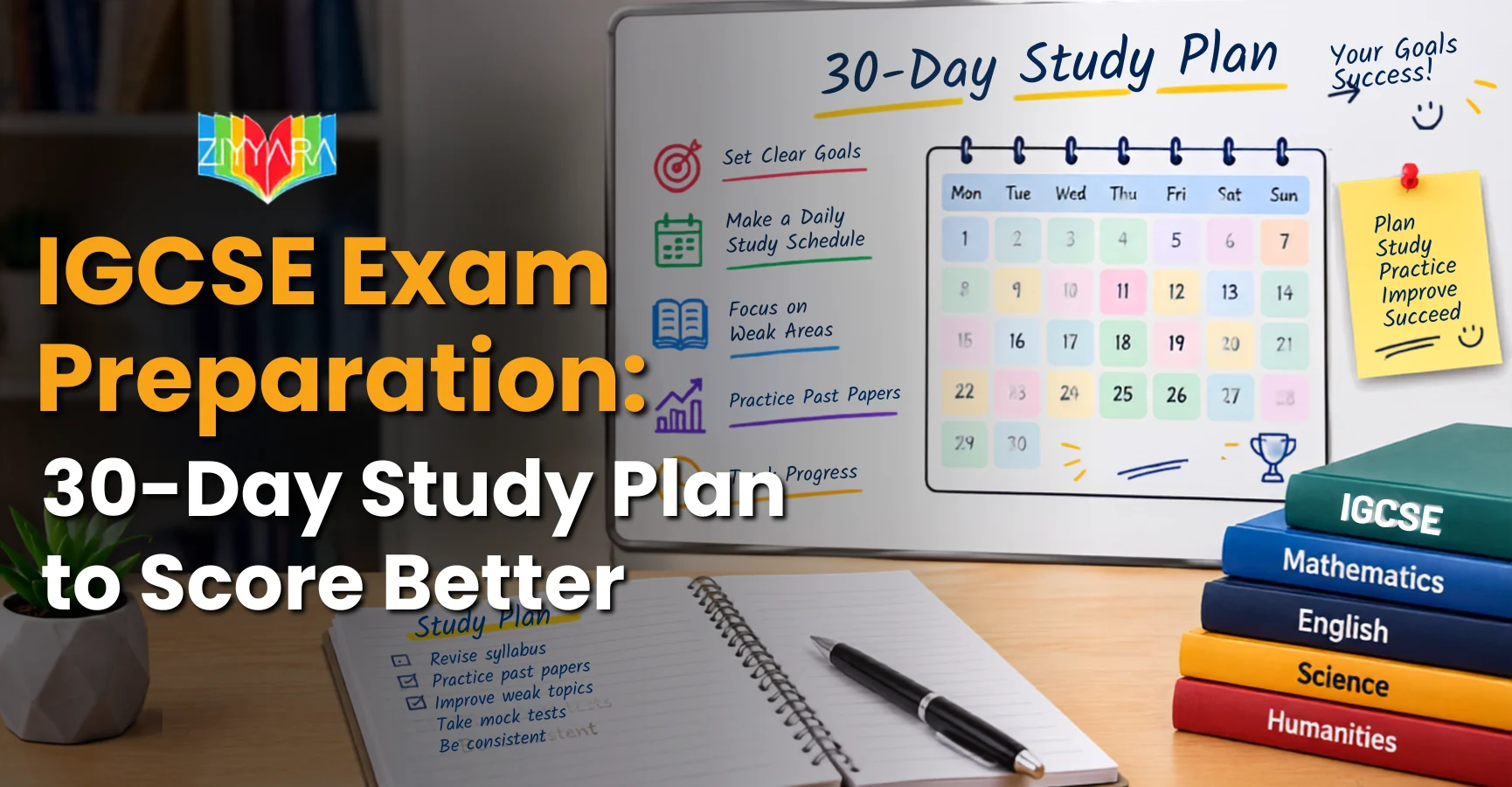
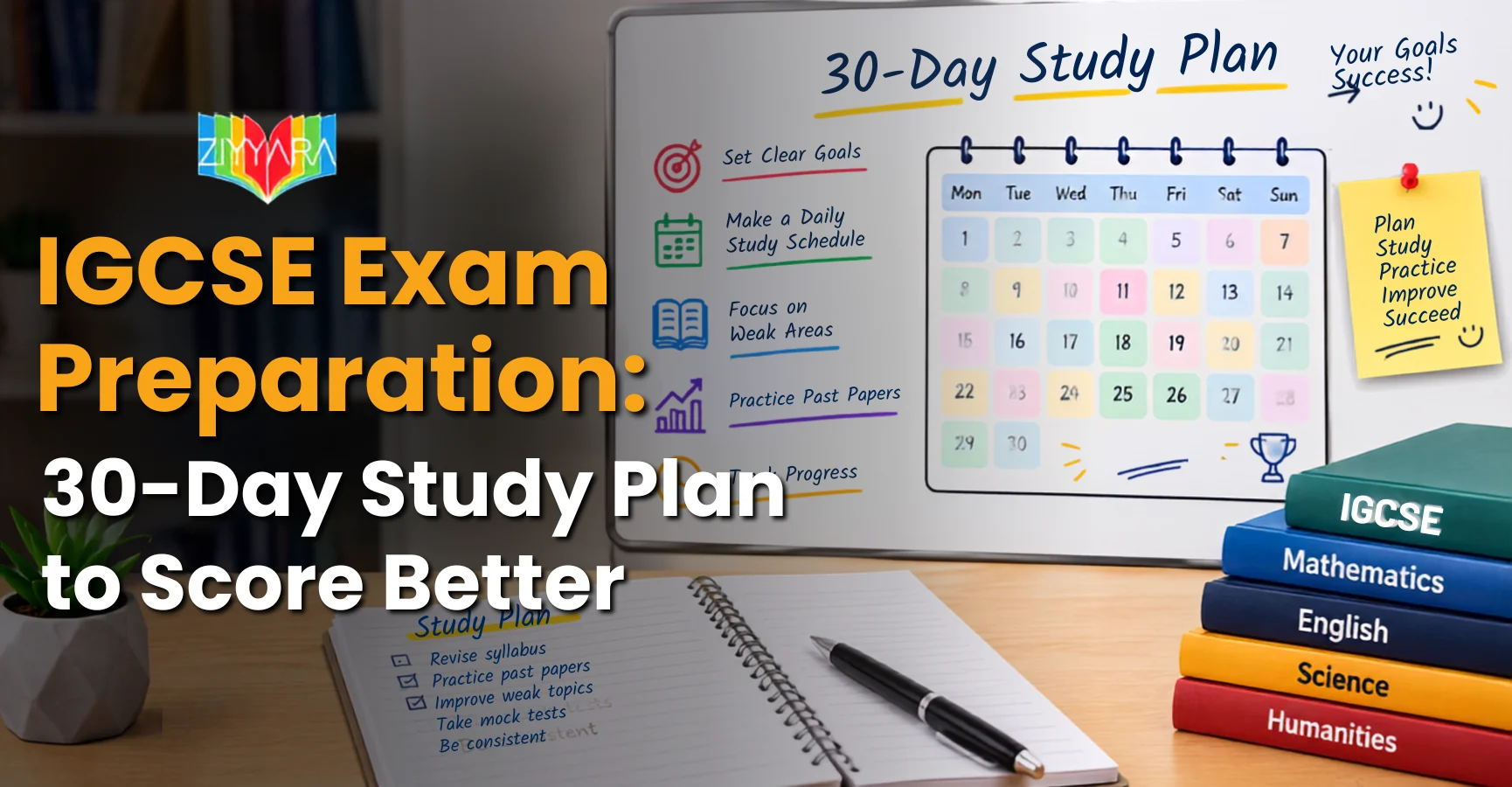
IGCSE Exam Preparation: 30-Day Study Plan to Score Better
The process of preparing for IGCSE examinations may seem daunting with such a big syllabus when the exam is approaching. Fortunately, it only takes 30 days to organize yourself and prepare effectively if you have a well-laid out plan.
Rather than revising randomly, break down your 30 days to 4 phases; understand, revise, practice, and test.
Below is an example of an IGCSE revision schedule for 30 days that students can use.
30-Day IGCSE Revision Plan
Days
Focus
What to Do
1–7
Syllabus Review
Identify strong and weak topics
8–15
Concept Revision
Revise important concepts and practise questions
16–23
Past Papers
Solve timed exam-style questions
24–27
Weak Areas
Fix repeated mistakes and difficult topics
28–30
Final Revision
Revise key points and prepare for exams
Days 1–7: Identify Your Weak Topics
Before beginning the revision process, understand your position.
Look at the syllabus for all the subjects and classify the topics into three categories:
Strong – You have complete knowledge of the topic and can answer questions independently.
Average – You have basic knowledge but require more practice on the same.
Weak – You find the topic tough to comprehend and solve questions.
Allocate more time to weak and average subjects rather than revising the ones that you know well.
Create a daily target like 2 difficult topics + 1 easy topic.
During the second week, learn to grasp the concepts rather than merely studying your notes.
For every topic:
Revise the main concept.
Write down important formulas, definitions or keywords.
Solve practice questions without looking at the solution.
Check your answers.
Note down every mistake.
This approach would come in handy especially in IGCSE Mathematics, Physics, Chemistry, and Biology because you need to understand the concept and apply it to the question.
For English and other theoretical subjects, structure your answers and arguments well.
Days 16–23: Solve IGCSE Past Papers
Week three should be all about doing past paper questions.
Start answering papers with timing. This allows you to see the question style and the area that you are losing marks from.
This shouldn’t end once you have marked the paper.
For every incorrect answer, ask:
“Why did I lose this mark?”
Was it because you:
Didn’t understand the concept?
Misread the question?
Forgot an important keyword?
Made a calculation mistake?
Didn’t explain your answer properly?
Ran out of time?
Maintain a mistake tracker and revise these areas regularly.
Days 24–27: Fix Your Weakest Areas
Now use your past-paper results to identify your biggest problem areas.
In case you keep on scoring low marks in the same topics, then revisit the concepts and practice them again.
Follow this simple cycle:
Revise → Practise → Check → Correct → Repeat
Do not waste your four days going over the entire syllabus once again. Concentrate on those topics which will help you most.
Days 28–30: Final IGCSE Revision
Your last three days should be spent in quick revision and building up confidence.
Revise:
Important formulas
Key definitions
Difficult concepts
Important diagrams
Common mistakes
Frequently practised questions
Your personal mistake list
Avoid starting several new topics at the last minute. Focus on strengthening what you already know.
How Many Hours Should You Study for IGCSE?
The number of hours does not apply to everyone. It depends on your subjects and how ready you are and what your school plans are.
Instead of thinking about hours, create goals for each day.
Here are some examples:
Cover 2 chapters
Answer 30 Maths questions
Answer one Science paper
Memorize 10 vocabulary words
Clear your mistakes from yesterday’s homework
Studying is better than spending hours and hours with books aimlessly.
5 IGCSE Exam Preparation Tips
Adhere to the syllabus: It will serve as your revision guide.
Practice continuously: Do not leave the past papers to the last few days.
Learn from your mistakes: They show the areas where you need to improve.
Revise actively: Instead of just reading your notes over and over again, test yourself.
Take breaks: Breaks will help you concentrate better in long periods of studying.
Need Personalised IGCSE Exam Preparation?
Everyone is different when it comes to studying. Some students may be poor at maths whereas some may need help in Science, English or examinations.
With the help of Ziyyara’s one-to-one online IGCSE tuition classes which are tailored according to your individual needs can make a difference. Personalized tutors at Ziyyara can assist you in finding areas that pose a problem for you, clarify difficult concepts, practice exam-based questions and ensure revision.
Your child requires assistance in preparing for an IGCSE exam in the coming month? You can get a customized study plan designed around their subjects and level.
Get Started With Your IGCSE Preparation for 30 Days
It does not matter if you have to revise the entire syllabus. Begin with one subject, one topic and one focused study session.
In just 30 days of IGCSE preparation, your studies can become extremely effective if you follow a structured plan.