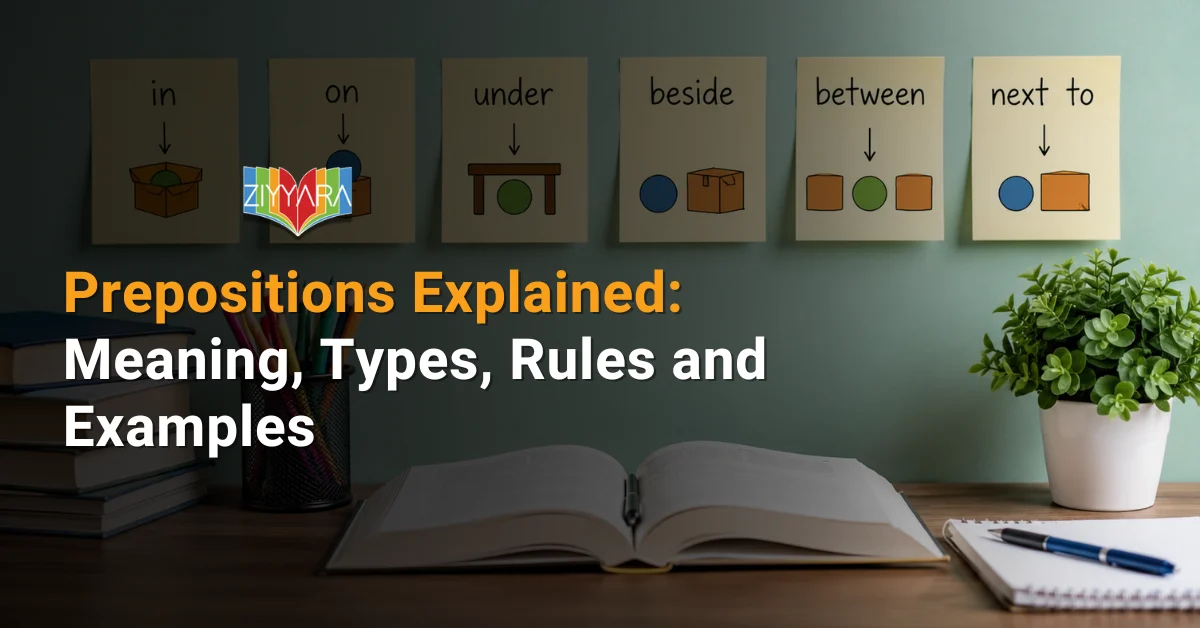
Prepositions Explained: Meaning, Types, Rules and Examples
Prepositions are one of the cornerstones of English grammar. They help us to form the relationship between persons, places, things and time. From a school student to competitive exams, everyone needs to be aware of Prepositions in English and also if you just want to enhance your communication skills.
This guide will teach you what prepositions are, their meaning types, usage rules and a lot of examples to help you use them with confidence.
What Are Prepositions?
If you’ve ever asked yourself what are preposition? Prepositions – A preposition is a word used to connect nouns or pronouns with the other words in a sentence. It refers to location, direction, time, cause or relationship.
The meaning of prepositions lies in the relationship they create between words. They provide additional information about where, when, how, or why something happens.
For example:
In the classroom (place)
At 9 a.m. (time)
With my friend (association)
For two hours (duration)
Without prepositions, sentences would often sound incomplete or confusing.
Types of Prepositions
Understanding the types of prepositions makes it easier to use them correctly. Here are the main categories:
1. Prepositions of Time
These indicate when something happens.
Examples:
at
on
in
before
after
during
Sentence: The exam starts at 10 a.m.
2. Prepositions of Place
These describe the position or location of something.
Examples:
in
on
under
behind
between
beside
Sentence: The keys are under the sofa.
3. Prepositions of Direction or Movement
These show movement from one place to another.
Examples:
to
into
across
through
towards
onto
Sentence: She walked into the classroom.
4. Prepositions of Manner, Cause, and Purpose
These explain how or why an action happens.
Examples:
by
with
because of
for
Sentence: The letter was written by the principal.
Rules of Prepositions
Having the correct knowledge of the rules of prepositions can help you avoid common grammar mistakes.
Use at for precise times, on for days and dates and in longer periods such as months, years or decades.
Use in for enclosed spaces and on for surfaces.
Use between when two people or things are involved and among for three (or more).
Do not translate prepositions directly from your native language, as English usage can differ.
Learn common verb-preposition combinations such as depend on, listen to, and believe in.
Prepositions with Examples
The best way to master grammar is by learning prepositions with examples.
Preposition
Example Sentence
In
The books are in the bag.
On
The laptop is on the desk.
At
We met at the bus stop.
Under
The cat is under the chair.
Between
The school is between the park and the hospital.
Through
The train passed through the tunnel.
During
It rained during the match.
Since
She has lived here since 2020.
Common Mistakes Students Make
A few mistakes to avoid while using English prepositions:
❌ She is good in Maths. ✅ She is good at Maths.
❌ We discussed about the project. ✅ We discussed the project.
❌ He arrived to school late. ✅ He arrived at school late.
The more you read and practice the easier it becomes to use them naturally.
Tips to Learn Prepositions Easily
Read English books, newspapers and articles on a regular basis.
Use other prepositions to write short paragraphs.
Learn phrases rather than words
Solve grammar worksheets and quizzes.
Observations how prepositions in English grammar are used during everyday life dialogues & writings.
Frequently Asked Questions (FAQs)
1. What are the basic rules for using prepositions?
Some basic rules include:
Use at for specific times.
Use on for days and dates.
Use in for months, years, and enclosed spaces.
Use between for two people or things and among for three or more.
Instead of translating them from one language to another, learn common verb-preposition combinations.
2. Why are prepositions important in English grammar?
Prepositions help to relate things in a sentence. They are what allows us to make sense of where, when or how something is done in English- without them you would still understand the surety action but not its context.
3. How can students improve their use of prepositions?
Students can improve by reading English regularly, practicing grammar exercises, learning prepositions in context, and using them while speaking and writing. Consistent practice is the key to mastering prepositions.
4. What is the difference between prepositions and conjunctions?
A preposition connects a noun or pronoun to another word in the sentence (The bag is on the table) whereas the conjunction connects words, phrases or clauses (I wanted to go but it was raining).
5. What is the easiest way to learn prepositions?
The most convenient way is to understand them in real life sentences, through some common examples instead of memorizing lists. To know how to use prepositions naturally, you need to read a lot, listen a lot and practice a lot.
Conclusion
Prepositions are small in nature but huge in importance. The role that prepositions play to build the meaning of relation between two sentences, words or phrases is quite big and without them they become confusing or incomplete. Both your writing as well as speaking skills may be enhanced by studying their meaning, exploring the types, following basic rules and practicing examples.
With continuous practice each day, you will be using the prepositions correctly as easily as riding a bicycle in no time.