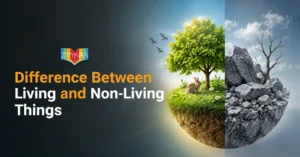
Think about a tree, a dog, a bird, and a person. Now think about a chair, a rock, a book, and a toy. You already know the first group is alive and the second isn’t. But why? What do the first group have in common that a chair doesn’t?
It comes down to life processes. Living things do a handful of specific things on their own, and non-living things don’t. We’ll go through them, with examples, a simple diagram, and a few tricky cases that trip people up.
What Are Living Things?
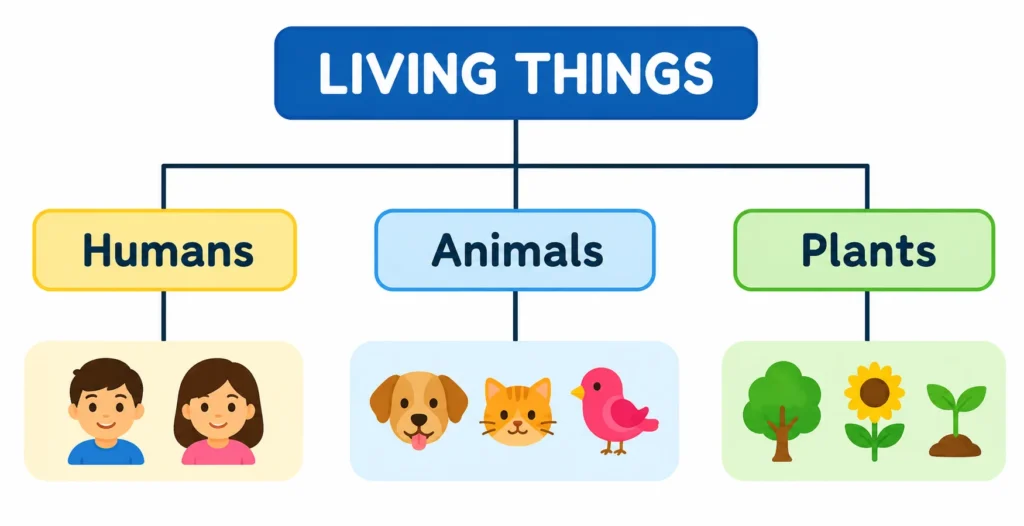
Living things, or organisms, are anything that eats or takes in nutrients, breathes, grows, reproduces, reacts to its surroundings, and gets rid of waste. You’ll find them everywhere, from bacteria you can only see under a microscope to giant trees and blue whales.
Living things share a few traits, and each one is easy to spot once you know what to look for.
1. They Need Food or Nutrients
Every living thing needs energy to keep going. Animals get it by eating plants or other animals, so a cow munching grass is fueling up. Plants skip the eating part and make their own food through photosynthesis.
2. They Respire
Respiration is how a living thing releases energy from its food. When you breathe in oxygen and breathe out carbon dioxide, that’s part of it. Plants do it too, even though they make their own food. Plenty of people don’t realize that.
3. They Grow
A baby becomes an adult. A tiny seed becomes a tall plant.
Seed → Small Plant → Bigger Plant → Mature Plant
4. They Reproduce
Cats have kittens, birds lay eggs, plants make seeds. No single organism lives forever, but reproduction keeps the species going from one generation to the next.
5. They Respond to Their Surroundings
Sunflowers turn toward the sun. Touch something scorching hot and your hand jerks back before you’ve even thought about it. Both are responses to a change in the environment.
6. They Remove Waste
Living things produce waste just by staying alive, and they have to get rid of it. Humans do it through urine, sweat, and the air we breathe out.
What Are Non-Living Things?
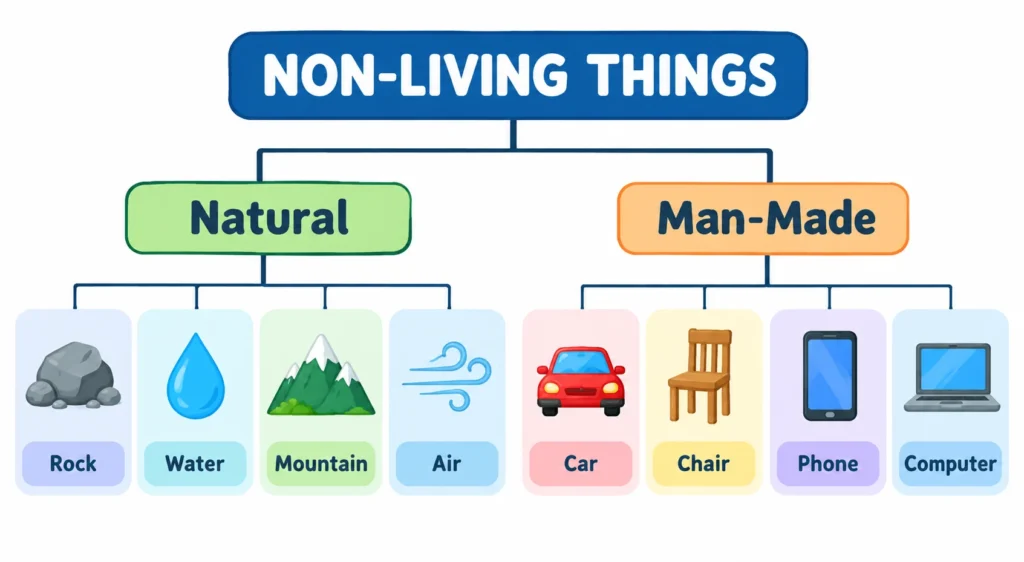
Non-living things don’t carry out any of these processes by themselves. They don’t eat, breathe, grow, or reproduce. Some are natural, and some are made by people.
Examples of Non-Living Things
Natural: rocks, water, air, sand, mountains
Man-made: cars, chairs, books, computers, mobile phones
Difference Between Living and Non-Living Things
Feature
Living Things
Non-Living Things
Need food/nutrients
Yes
No
Respire
Yes
No
Grow naturally
Yes
No
Reproduce
Yes
No
Respond to stimuli
Yes
No
Remove waste
Yes
No
Need water
Generally, yes
Not to stay “alive”
Made of cells
Yes
Generally, no
Have a life cycle
Yes
No biological life cycle
Examples
Humans, plants, animals
Rocks, chairs, cars
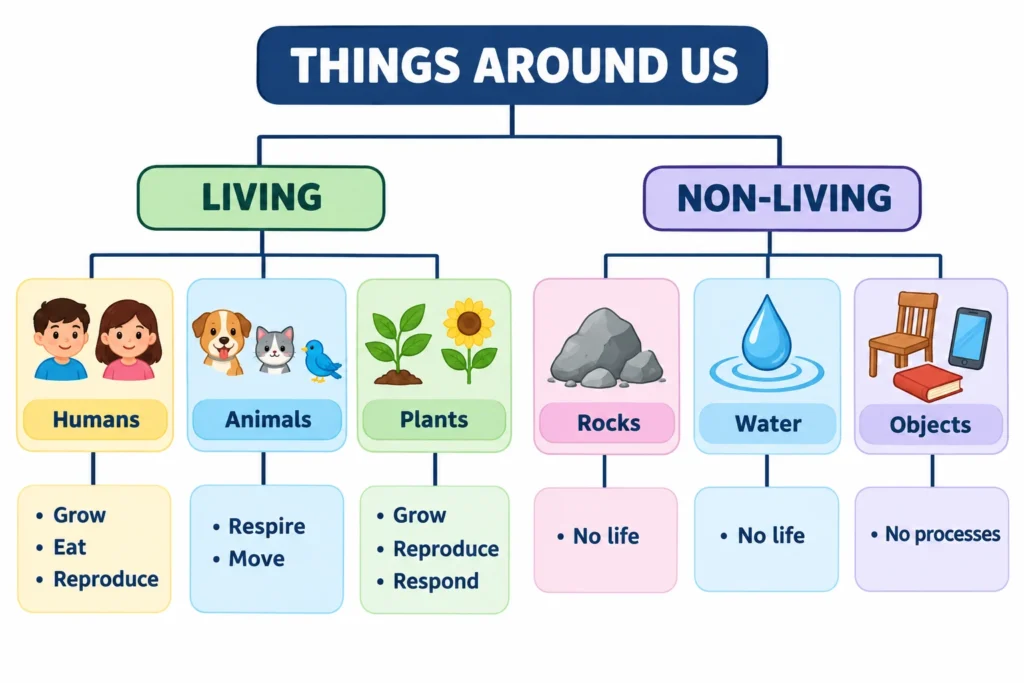
Living vs Non-Living: Easy Diagram
Are Plants Living Things?
Yes, definitely. They don’t walk around like animals, which fools some people, but they do everything on the list. They take in water and nutrients, respire, grow, reproduce, make their own food, and respond to their environment. A plant on a windowsill will lean toward the light.
Is Fire a Living Thing?
It’s a fair question, because fire seems to act alive. It spreads, it “eats” fuel, it gives off waste like smoke and ash. But fire isn’t made of cells, it doesn’t reproduce biologically, and it doesn’t carry out the full set of life processes. It’s a chemical reaction, not an organism.
Is a Car a Living Thing?
A car moves, makes noise, and runs on fuel, so it can look the part. But it doesn’t grow, reproduce, or respire biologically, and it isn’t made of cells. It moves because of its engine and electrical systems, not because it’s alive.
Simple Way to Remember the Difference
When you’re not sure, ask one question: does this thing carry out biological life processes on its own?
DOES IT PERFORM LIFE PROCESSES?
│
┌──────┴──────┐
│ │
YES NO
│ │
LIVING NON-LIVING
│ │
🌱 Plant 🪨 Rock
🐶 Dog 🚗 Car
👨 Human 📚 Book
One caution: don’t rely on any single trait. Movement is the classic trap. Cars move and aren’t alive, while a seed sitting perfectly still is very much alive, just waiting for the right conditions to germinate.
Conclusion
Living things get energy, respire, grow, reproduce, respond to their surroundings, and deal with waste. That’s the whole difference. Rocks, water, chairs, books, and cars do none of that on their own. Once you know what to look for, sorting the world into the two groups gets easy.
Quick Revision
Living things → grow, respire, need nutrients, reproduce, respond, remove waste
Non-living things → don’t perform biological life processes