Forest and Wildlife Resources Class 10 Geography - Complete CBSE Study Guide
Introduction to Forest and Wildlife Resources
Forest and Wildlife Resources is a very crucial chapter of Class 10 Geography. It depicts the significance of forests, the threats to biodiversity and attempts made by the government of India to save its natural resources.
Students, who take geography online classes, will find that chapter interesting as it is directly related to environmental issues and conservation efforts taking place all around us. This guide will help you revise all the important concepts in a simple and exam-oriented manner.
Why Is the Value of Forests and Wildlife?
Forests are much more than a collection of trees. Life on Earth can thrive in them.
Importance of Forests
They control the climate and water cycle.
They help stop soil erosion and prevent flooding.
They are able to absorb carbon dioxide and produce oxygen.
They serve as a habitat for thousands of species of plants and animals.
They are vital to the livelihoods of millions of people, particularly tribal.
Students enrolled in online geography classes often learn how forests play a crucial role in maintaining ecological balance and protecting biodiversity.
India is one of the megadiverse countries of the world with almost 8% of the global biodiversity and conservation is a national agenda.
India is a land of extraordinary variety of plants and animals.
Biodiversity in India
Over 47,000 species of plants.
Approximate number of animal species (mammals, birds, fish and insects).
Classification tables are used by many tutors in online geography tuition which help students to memorize the various types of species.
IUCN (International Union for Conservation of Nature) Categories of Species
Category
Meaning
Normal Species
Populations at safe levels, such as cattle and rodents
Endangered Species
Species facing a high risk of extinction, such as black buck and Indian wild ass
Vulnerable Species
Species whose populations are declining, such as blue sheep
Rare Species
Species with small populations, such as Himalayan brown bear
Endemic Species
Species found only in specific regions, such as Andaman teal
Extinct Species
Species that no longer exist, such as Asiatic cheetah
Students taking online tuition for Geography often revise these categories using charts and flashcards to improve retention.
Major Causes of Loss of Forests and Wildlife
From the examination point of view it is important to understand why biodiversity is lost.
1. Habitat Destruction
Forests have been felled to use for farming, industries, roads, dams and development of cities.
2. Hunting and Poaching
Illegal hunting for skin, horns, bones, and other body parts has threatened several species.
3. Environmental Pollution
Industrial pollution, pesticides and air pollution cause harm to wildlife and ecosystems.
4. The introduction of Aliens species
Non-native species are pests that disrupt the ecology and compete with native species.
5. Colonial Policies
Forests were massively exploited during the British rule for timber and agricultural expansion, leading to long term environmental damage.
Geography online tuition can help students understand many concepts more easily with the help of real-life examples and case studies.
Classification of Forests in India
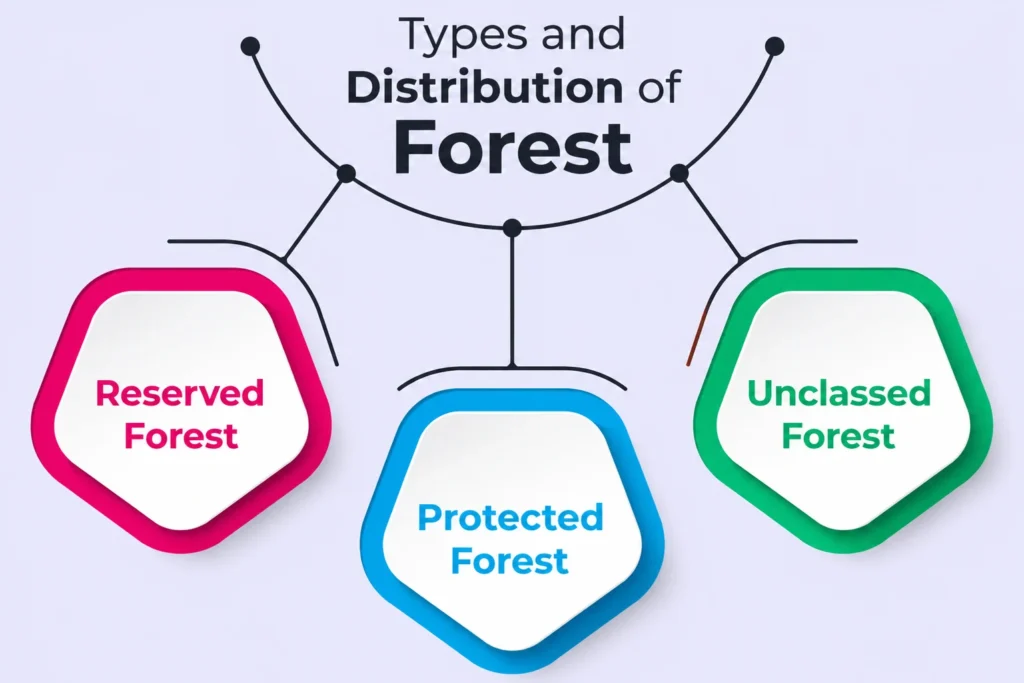
This is one of the most significant topics for board exams. As per Indian Forest Act, there are three types of forests which are as follows:
These are the commonly taught topics in Geography tuition classes, where comparison questions are asked.
1. Reserved Forests
The majority of strictly protected forests.
Cover about 54% of the total forest area.
Local communities have virtually no rights.
Occurring in Madhya Pradesh and Jammu & Kashmir.
2. Protected Forests
Occupy almost 29% of the forest land in India.
The government has protected it from any further depletion.
Certain rights are provided to local communities.
3. Unclassed Forests
Cover 17% of forest land area.
Owned by governments or communities or private individuals.
Have less legal protection than others.
In the northeast states as well as Gujarat.
Students enrolled in tuition classes of Geography often use memory tricks to avoid confusion between Reserved and Protected forests.
Exam Tip
Be aware that Reserved Forests are the most protected (though less so than Protected Forests as their name implies).
Conservation of Forests and Wildlife in India
India has enacted a number of steps for protection of forest and wildlife.
Students looking for the best online geography tuition tend to amend these projects with questions and quizzes.
Indian Wildlife (Protection) Act, 1972
Provides legal protection to wildlife and their habitats.
Bans the hunting of endangered animals.
Sets up conservation reserves.
Project Tiger (1973)
It was started with a view to saving the Bengal tiger population.
Created Tiger Reserves in India.
Strengthened anti-poaching measures.
Biosphere Reserves, National Parks and Wildlife Sanctuaries
Biosphere Reserves
Large-scale, whole-ecosystems conservation areas.
National Parks
Zones in which the protection is 100% for wildlife.
Wildlife Sanctuaries
Protected areas with some human activities allowed.
Community Participation in Conservation
Local communities have played a significant role in conserving forests and wildlife.
Chipko Movement
Villagers in Uttarakhand hugged trees to stop deforestation.
Beej Bachao Andolan
A movement started in Tehri to preserve traditional crop diversity.
Bishnoi Community
Known for protecting trees and wildlife, especially the blackbuck.
Quick Revision Notes for Class 10 Exams
India is one of the world’s biodiversity-rich countries.
Habitat destruction and poaching are major threats to biodiversity.
Forests are classified into Reserved, Protected, and Unclassed categories.
The Indian Wildlife Protection Act of 1972 is a major conservation initiative.
Project Tiger was launched in 1973.
Community participation is essential for successful conservation.
Species are classified as Normal, Endangered, Vulnerable, Rare, Endemic, and Extinct.
Study Smarter with Ziyyara
It can sometimes be difficult to remember the classifications, examples and conservation projects. The 1:1 learning sessions with Ziyyara make Geography easier and more interesting.
Ziyyara’s personalized attention and live interactive sessions are designed to boost student confidence and enhance their performance in Geography, whether they are studying to grasp concepts or preparing for board exams.