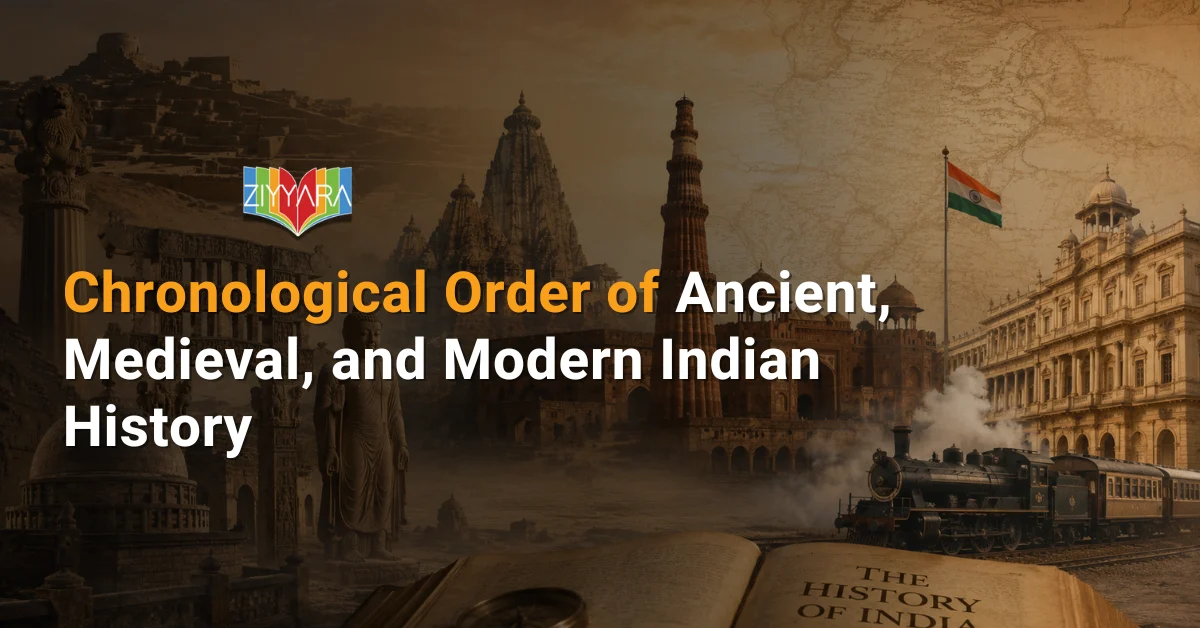
Chronological Order of Ancient, Medieval, and Modern Indian History
Indian history has been broadly categorized into three phases: Ancient, Medieval, and Modern periods. Knowledge about Indian history in chronological order will help students to link events, rulers, and developments in an easy manner instead of learning it randomly.
Ancient Indian History (3300 BCE – 550 CE)
Ancient India starts from ancient civilization and ends at the Gupta era.
Indus Valley Civilization (3300–1300 BC): One of the ancient civilizations of the world, including cities like Harappa and Mohenjodaro.
Vedic Period (1500 – 600 BC): Religion of Hinduism and caste system were developed.
Mahajanapadas (600 – 300 BC): There were sixteen kingdoms that existed in northern India during this period.
Mauryan Empire (322 – 185 BC): Established by Chandragupta Maurya and followed Buddhism under Ashoka.
Gupta Empire (320 – 550 AD): Referred to as the “golden age.
This period saw the formation of different kingdoms along with cultural progressions.
Medieval Era Kingdoms: Rajputs, Cholas, and Palas were the dominant kingdoms in their own territories.
Delhi Sultanate (1206-1526): Period when India came under the control of Islam.
Vijayanagara Empire (1336-1646): Empire of Southern India.
Mughal Empire (1526-1707): Empire founded by Babur, whose kings included Akbar, Jahangir, and Shah Jahan.
Bhakti-Sufi Movement: Based on devotion
Modern Indian History (1700 CE – 1947 CE)
They include the rule of the British Empire and fight for freedom in India.
Rule of the British East India Company (1757 onward): Commences after the Battle of Plassey.
Rebellion of 1857: It was the first rebellion against the British Empire.
Establishment of INC (1885): The establishment of INC made Indians politically aware.
Freedom Struggle: Non-Cooperation Movement, Civil Disobedience Movement, and Quit India Movement.
Independence (1947): Independence of India in 1947.
Modern India (Post 1947 Development)
India experienced development and progress during the post-independence era.
Constitution making (1950)
Green revolution (increase in food production)
Liberalization of economy (1991)
ISRO and its space exploits
Technological development with Digital India
Why Is Indian History Important in Education?
Understanding Indian history involves more than simply memorizing dates, kings, or battles. It helps students comprehend how the Indian civilization and culture have progressed over the centuries, as well as how India’s governance has developed. The chronological study of Indian history makes it possible for students to correlate events and know how one event influenced the other event. It is more efficient as students would find it easy to remember events logically than learning events in an isolated manner. It is helpful when preparing for any exams whether for schools, competitive examinations, or even for general knowledge.
Why Learning History in Chronological Order is Important?
Helps in memorizing events in sequential manner
Enables better comprehension of causality
Aids in better exam preparations
Creates sound base of general knowledge
Beneficial for CBSE, UPSC and other competitive exams.
FAQs on Chronological Order of Indian History
Q1. What is the correct chronological order of Indian history?
History of India is classified as Ancient (3300 BCE–550 CE), Medieval (550 CE–1700 CE), and Modern (1700 CE–1947 CE) and Post Independence.
Q2. Why is Indian history divided into periods?
This makes it easier for the students to comprehend various transformations in the social, political, cultural, and economic context.
Q3. What is the Golden Age of India?
The Golden age of Indian History is the Gupta period (320-550 CE) because of scientific advancements in arts and literature.
Q4. Which event marks the beginning of modern Indian history?
The Battle of Plassey in 1757 marks the beginning of British rule in India.
Q5. What is the most important period in Indian history for exams?
All eras have their significance, but Modern Indian History is of great importance for educational tests and competitive examinations.
Conclusion
Studying the chronology of Ancient, Medieval and Modern History of India helps students learn about the development of India through thousands of years from Indus Valley Civilization till Digital India today.